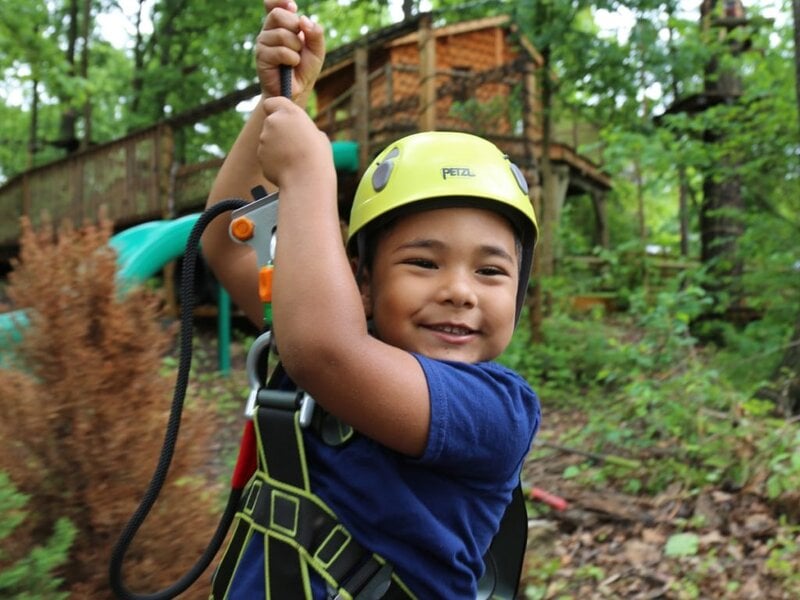
Yes, zip lining is safe for kids when the zip line operates under established industry safety standards with trained staff, continuous belay systems, daily equipment inspections, and proper harness fitting. A study published in the American Journal of Emergency Medicine by researchers at Nationwide Children’s Hospital found that the overall injury rate for ziplining is approximately 11.64 per 1 million participants. To put that number in context, a child is statistically safer on a professionally operated, standards-compliant zip line than she is riding in the car on the way to the activity. The critical variable is not whether zip lining is inherently dangerous. It is whether the specific zip line your child rides meets the safety standards set by the Association for Challenge Course Technology (ACCT) and the American Camp Association (ACA). This article explains what the injury data actually shows, why camp zip lines have a different risk profile than backyard or unregulated setups, what safety systems protect your child, and what parents should look for when evaluating any zip line program.
What Is the Injury Rate for Zip Lines?
The injury rate for zip lines is approximately 11.64 per 1 million participants, according to a landmark study published in the American Journal of Emergency Medicine by researchers at the Center for Injury Research and Policy at Nationwide Children’s Hospital. The study found that an estimated 16,850 non-fatal zip line injuries were treated in U.S. emergency departments from 1997 through 2012. Nearly 70% of those injuries occurred during the last four years of the study period, reflecting the rapid growth in zip line popularity rather than a decline in safety.
The study also found that children under 10 accounted for 45% of zip line injuries, and youth ages 10 to 19 accounted for an additional 33%. These numbers sound alarming until you examine where the injuries occurred. A significant portion, approximately 30.8% according to forensic analysis, happened on residential or backyard zip lines, setups that lack professional installation, maintenance schedules, trained staff, and safety equipment like harnesses and helmets. For the younger age group, nearly 90% of injuries resulted from falls, often because the child lacked the upper-body strength to hold onto a handlebar-only system or was not wearing a harness at all.
The data draws a clear line between regulated and unregulated zip lines. Injuries cluster overwhelmingly in settings without professional oversight. At ACA-accredited camps that follow ACCT standards, children ride zip lines wearing full-body harnesses clipped into continuous belay systems, supervised by trained facilitators, on equipment that is inspected daily and certified annually by third-party professionals. The risk profile of a camp zip line operating under these conditions is fundamentally different from the risk profile of a backyard cable strung between two trees.
What Are the Risks of Ziplining?
The risks of ziplining, based on the Nationwide Children’s Hospital study data, break down into specific injury types and mechanisms:
- Falls accounted for 77% of all zip line injuries. In unregulated settings, falls typically occur when a rider loses grip on a handlebar, is not wearing a harness, or encounters an abrupt stop. On a camp zip line with a continuous belay system and full-body harness, falling off the line is physically prevented by the equipment.
- Collisions with structures accounted for 13% of injuries. These occur when a rider reaches the end of the line too fast and strikes a tree, pole, or platform. Professional zip lines use braking systems, either passive (gravity-assisted deceleration) or active (staff-controlled), to slow the rider before arrival. Camp zip lines are designed with appropriate braking zones and trained staff at the landing platform.
- Fractures were the most common injury type, occurring in 46% of cases. Bruises accounted for 15.2%, strains and sprains for 15.1%, and concussions or closed head injuries for 7%. Helmet use, which is standard on camp zip lines but often absent on backyard setups, significantly reduces the risk of head injuries. ASTM/SEI-certified helmets reduce serious head injury risk by more than 70%.
- Hospitalization was required in more than 10% of cases, a rate the study’s lead researcher called “much higher and more serious than we see with a lot of studies.” Again, the severity data is driven by unregulated settings where basic safety equipment is absent.
The consistent finding across the research is that zip line injuries are largely preventable with proper equipment, trained staff, and adherence to industry standards. The risks that concern parents, cable failure, harness failure, falling from extreme heights, are virtually eliminated on professionally operated camp zip lines. ACCT data indicates that the probability of a cable breaking on a standards-compliant zip line is approximately 1 in a billion.
What Makes a Camp Zip Line Safer Than Other Zip Lines?
A camp zip line is safer than other zip lines because it operates within a multilayered safety system that commercial tourism operations and backyard setups often lack. The differences are structural, not cosmetic, and each layer independently reduces risk.
First, camp zip lines at ACA-accredited facilities follow ACCT standards. ACCT, founded in 1993 and recognized as an ANSI Accredited Standards Developer since 2006, publishes comprehensive requirements covering zip line construction, equipment specifications, staff training, participant management, and emergency procedures. These standards represent the highest safety benchmark in the industry. Our camp holds both ACA accreditation with a 100% standards score and ACCT certification, which means every element of our zip line program has been independently reviewed and approved.
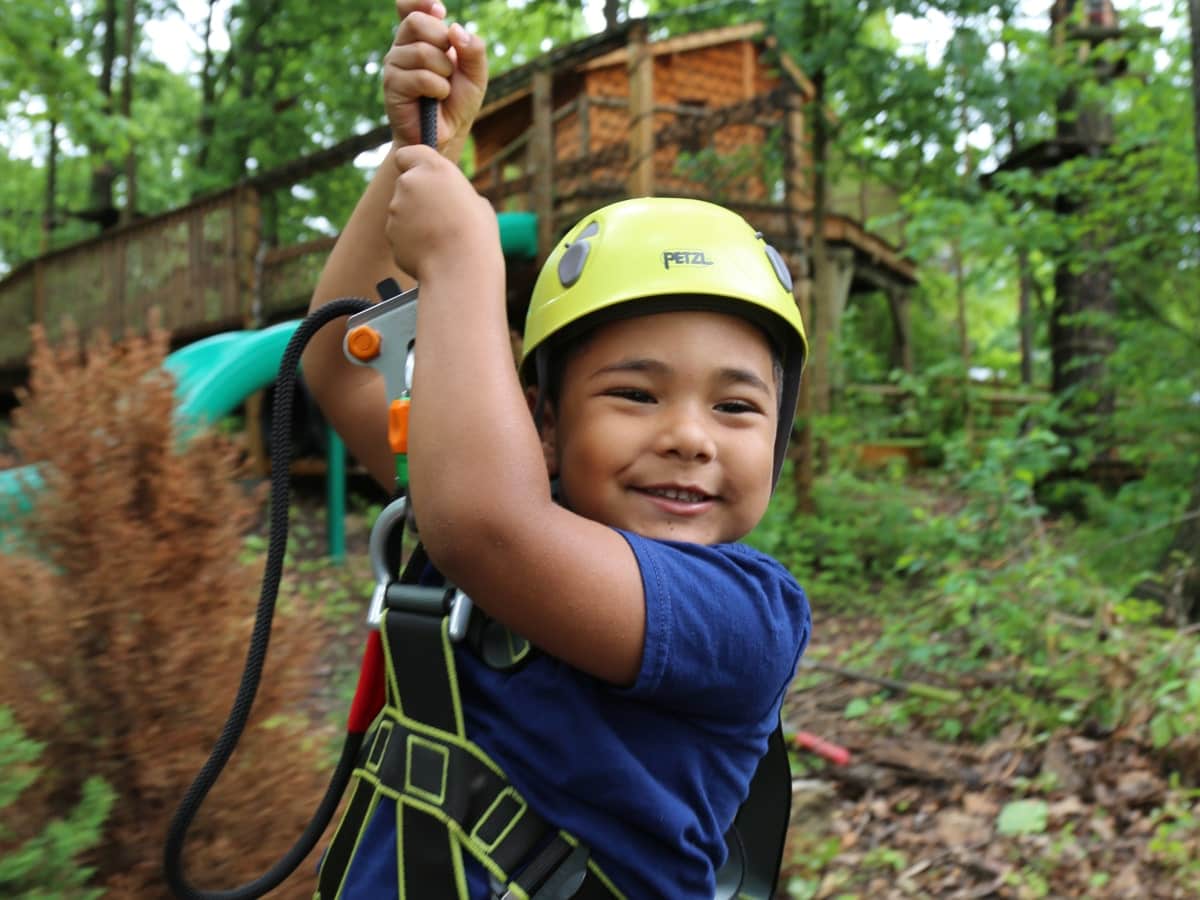
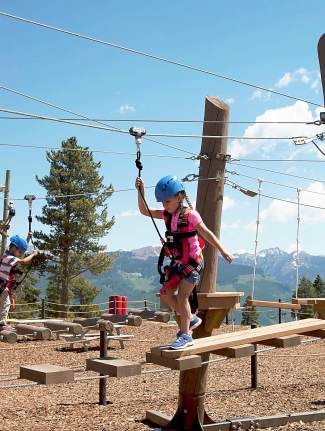
Second, camp zip lines use continuous belay systems. The child clips into a full-body harness connected to a safety cable before she leaves the platform, and she remains connected until staff unclip her at the bottom. Modern continuous belay technology uses synchronized carabiners where only one can open at a time, making it physically impossible for the child to become detached from the safety line during the ride. This single feature eliminates the primary cause of serious zip line injuries: falls from the line.
Third, camp zip lines are staffed by trained facilitators at both the launch and landing platforms. Staff members fit and inspect each harness before the child approaches the line, brief every participant on body position and hand placement, control the launch timing, operate or monitor the braking system, and assist with the landing. Fourth, camp zip lines undergo daily equipment inspections before any participant touches the course. Cables, hardware, platforms, and braking systems are checked every morning. Annual third-party inspections by certified professionals verify that the entire system meets current ACCT standards.
Fifth, a camp zip line is typically one element within a broader ropes course program. The child does not walk up to a zip line cold. She participates in a safety briefing, wears her harness through multiple ropes course elements, and builds comfort with the equipment and the height before she ever approaches the zip line platform. This graduated exposure means she arrives at the zip line already familiar with the harness, the belay system, and the sensation of being elevated, which reduces panic and improves safety compliance.
| Safety Factor | ACA/ACCT-Accredited Camp Zip Line | Unregulated or Backyard Zip Line |
| Safety Standards | Meets ACCT/ANSI standards; ACA accreditation verified annually | No required standards; may not follow any safety guidelines |
| Harness System | Full-body harness with continuous belay; child cannot detach | Often handlebar-only with no harness; child can lose grip and fall |
| Staff | Trained, certified facilitators at launch and landing; pre-ride safety briefing | No trained staff; children often unsupervised |
| Equipment Inspection | Daily staff inspections plus annual third-party certification | No inspection schedule; equipment may degrade undetected |
| Braking System | Professional passive or active braking; controlled deceleration | Often no braking system; rider strikes end structure at speed |
| Helmet | ASTM/SEI-certified helmet required; reduces head injury risk by 70%+ | Helmet use inconsistent or absent |
| Injury Profile | Injuries are extremely rare under these conditions | 45% of all zip line injuries involve children under 10; 77% are falls (Nationwide Children’s Hospital) |
Sources: Nationwide Children’s Hospital / American Journal of Emergency Medicine (2015), Association for Challenge Course Technology (ACCT), American Camp Association (ACA), AAP HealthyChildren.org.
What Is the Youngest Age for Ziplining?
The youngest age for ziplining depends on the specific operator’s guidelines, the design of the zip line, and the child’s ability to fit a safety harness properly and follow multi-step instructions. Most camp programs set a minimum age between 7 and 10 for high zip lines, based on the child’s physical size (harnesses have minimum weight and height requirements) and cognitive readiness (the child must understand and follow safety directions from the facilitator).
The Nationwide Children’s Hospital study found that children under 10 accounted for 45% of zip line injuries nationally, but the study authors attributed this primarily to unregulated settings where harnesses were absent or improperly fitted. At a camp with ACCT-compliant equipment and trained staff who individually fit each harness, the risk profile for younger children is dramatically different. The key question is not “what is the minimum age” but “does the harness fit this child properly, and can she follow the safety briefing?” If both answers are yes, she is ready. Camp staff assess each participant individually before allowing her onto the course.
Is Ziplining Scary for Beginners?
Yes, ziplining is scary for beginners, and that is a normal, healthy response to standing on a platform above the ground and preparing to fly across open air on a cable. The fear is real. The danger, on a standards-compliant camp zip line, is not. This gap between perceived risk and actual risk is precisely what makes the zip line such a powerful developmental tool. A child who feels genuine fear, chooses to go anyway, and lands safely at the bottom with a grin on her face has just built a piece of confidence that no classroom exercise can replicate.
The ACA found that 74% of campers did things at camp they were initially afraid to do, and the zip line is one of the activities most frequently cited in that statistic. At our camp, the zip line is the culminating element of the challenge course experience. A child does not walk up to the zip line as her first activity. She completes a safety briefing, wears her harness through low ropes elements, builds comfort on high ropes elements, and arrives at the zip line platform already equipped with the skills and confidence she built on the earlier elements. The “challenge by choice” philosophy applies: no child is forced to zip if she does not want to. Many who hesitate on the platform ultimately choose to go after watching a cabin mate complete the ride safely and joyfully.
Can a Child Zipline If They Are Afraid of Heights?
Yes, a child can zipline if she is afraid of heights, and many camp counselors consider these children the ones who benefit most from the experience. Fear of heights (acrophobia) affects an estimated 2 to 5% of the general population and is especially common in children ages 10 to 13, according to Stanford Medicine Children’s Health. At camp, a child with a fear of heights is never forced onto the zip line. She progresses at her own pace through the ropes course, building comfort with height one element at a time.
The graduated exposure model that camp ropes courses use is the same principle that clinical psychologists use to treat phobias: repeated safe exposure to the feared stimulus recalibrates the brain’s threat response. A child who crosses a rope bridge at 15 feet, then navigates a cargo net at 25 feet, then stands on a platform at 30 feet has already built a neurological evidence base that height, while scary, does not equal danger. By the time she reaches the zip line, the fear is still present but the panic is gone. She has proof, in her own body, that she can handle it. The ACA found that 92% of campers said the people at camp helped them feel good about themselves, and the zip line is often the moment where that feeling crystallizes.
Who Should Not Go Ziplining?
Children who should not go ziplining include those who do not meet the minimum weight or height requirements for the harness system (requirements vary by operator but typically start around 50 to 60 pounds), children with certain medical conditions that could be aggravated by the harness pressure or the sudden deceleration at the end of the ride (such as recent surgery, spinal conditions, or pregnancy), and children who are not cognitively able to follow multi-step safety instructions. Camp staff assess each participant individually and will not allow a child onto the zip line if the harness does not fit properly or if the child cannot demonstrate understanding of the safety protocol.
Children who are simply scared, however, are not in the “should not” category. Fear is expected and is addressed through the “challenge by choice” model. A scared child who meets the physical and cognitive requirements can choose to try the zip line at whatever point during the session she feels ready. There is no pressure and no deadline. Many campers who skip the zip line on day one ride it multiple times by the end of the session. Camp activities like horseback riding, swimming, and archery all follow the same model: gentle encouragement, professional instruction, and full respect for the child’s pace.
What Should Parents Look for in a Safe Zip Line Program?
Parents should look for the following safety indicators when evaluating any zip line program their child might participate in. These apply whether the zip line is at a summer camp, an adventure park, or a scout outing:
- ACCT accreditation or inspection. Ask whether the facility has been inspected by an ACCT-accredited Professional Vendor Member or holds ACCT accreditation. ACCT is the industry’s gold standard for safety. If the operator cannot confirm an ACCT relationship, that is a significant red flag.
- ACA accreditation for camp programs. ACA-accredited camps meet over 300 health and safety standards. The accreditation process includes a review of the ropes course and zip line program specifically. An ACA-accredited camp with a 100% standards score has been independently verified as meeting every applicable standard.
- Full-body harness with continuous belay. Ask what type of harness system the zip line uses. The answer should be a full-body harness connected to a continuous belay cable, not a handlebar-only or sit-sling system. Continuous belay systems prevent the child from becoming detached at any point during the experience.
- Trained, certified staff. Ask about staff training. Facilitators should hold current ACCT practitioner certification or equivalent, have completed first aid and CPR training, and have practiced emergency rescue procedures specific to the zip line.
- Daily inspection protocols. Ask whether the equipment is inspected before each day of use. Professional operations inspect every cable, carabiner, harness, platform, and braking component daily, with documentation.
- A pre-ride safety briefing. Every participant should receive a verbal briefing covering harness fitting, body position, hand placement, braking procedures, and how to communicate with staff during the ride. If the operator skips the briefing or rushes through it, that is a concern.
- An emergency action plan. Ask what happens if a rider stops mid-line or if equipment malfunctions. Professional operations have documented rescue protocols and staff trained to execute them.
Reviewing what to expect at camp and reading the camp’s safety policies before enrollment gives parents the information they need to feel confident in the program. Parents who are preparing their daughter for camp can also contact the camp directly to ask these questions. Reputable camps welcome safety inquiries and are happy to walk families through their protocols in detail.
Frequently Asked Questions
Has a Zip Line Cable Ever Snapped?
Cable failure on a professionally installed and regularly inspected zip line is extraordinarily rare. ACCT data indicates that the probability of a cable breaking on a standards-compliant system is approximately 1 in a billion. Zip line cables used in professional operations are rated to hold thousands of pounds and are constructed from galvanized steel or stainless steel designed for sustained outdoor use. Daily visual inspections and annual load testing catch any degradation long before it reaches a failure threshold. The vast majority of zip line incidents documented in the research involve falls from the rider losing grip, not equipment failure.
Does Ziplining Feel Like Falling?
Ziplining does not feel like falling. The sensation is closer to gliding or flying. The rider is suspended in a harness attached to a cable that descends at a controlled angle, producing a smooth, forward-moving sensation with a gentle breeze. There is no freefall, no sudden drop, and no stomach-in-your-throat feeling. Children who are nervous about the “drop” sensation are often relieved to discover that the zip line feels calm and controlled once they leave the platform. The anticipation on the platform is usually scarier than the ride itself.
How Many People Get Hurt from Ziplining?
The Nationwide Children’s Hospital study documented approximately 16,850 non-fatal zip line injuries treated in U.S. emergency departments from 1997 through 2012, with the injury rate calculated at 11.64 per 1 million participants. The study’s lead researcher noted that while the injury rate is relatively low, the injuries that do occur can be serious. The critical context is that the injury data includes all zip line settings, from backyard ropes strung between trees to professional operations. Injuries at ACA/ACCT-compliant facilities represent a small fraction of the total because the safety systems in place prevent the most common injury mechanisms.
What Happens If You Get Stuck on a Zip Line?
If a rider stops mid-line on a camp zip line, trained staff execute a documented rescue procedure to bring the rider safely to the ground. Professional zip line programs plan for this scenario as part of their standard operating procedures. Staff are trained and regularly practice mid-line retrieval techniques. The rider remains safely suspended in her harness throughout the process. Getting stuck is uncommon on well-designed zip lines because the cable angle and rider weight are calculated to produce consistent travel to the landing platform, but when it does happen, the resolution is routine and safe.
Can a 5-Year-Old Go Zip Lining?
Whether a 5-year-old can go zip lining depends on the specific program’s age, weight, and height requirements. Most camp high ropes and zip line programs set a minimum age of 7 or 8 because the child must fit a full-body harness securely and demonstrate the cognitive ability to follow multi-step safety directions. Some adventure parks offer smaller, lower zip lines designed specifically for younger children ages 5 and up. Parents of young children should ask the operator about harness fit requirements and age-specific safety protocols before booking.
The Bottom Line for Parents
Zip lining is safe for kids when the operation follows ACCT and ACA standards, uses continuous belay systems with full-body harnesses, employs trained and certified staff, and inspects equipment daily. The injury data that concerns parents is driven overwhelmingly by unregulated, backyard, and handlebar-only setups that lack basic safety infrastructure. At an ACA-accredited camp with ACCT certification, your daughter rides a zip line inside a multilayered safety system designed to prevent every common injury mechanism the research has identified. The fear she feels on the platform is real and valuable. The danger is not.
On the banks of Little River in Mentone, Alabama, Riverview Camp for Girls has been helping girls discover what they are capable of since 1924. Our zip line, ropes course, and climbing tower are operated under ACCT guidelines and ACA standards with a 100% accreditation score. Enroll your daughter and let her experience the thrill of flying through the trees in the safest hands possible.