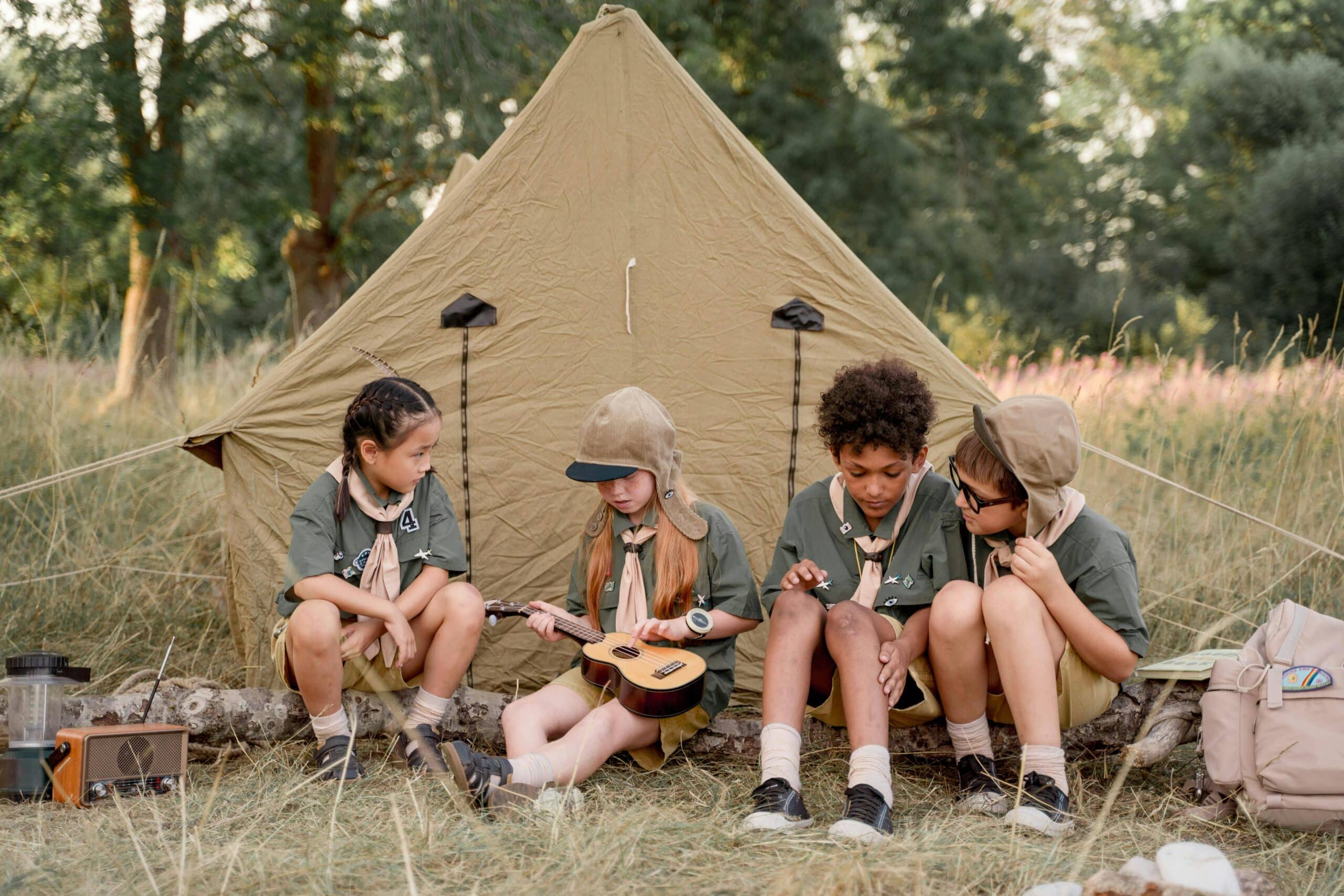

An all-girls camp gives daughters the freedom to lead, compete, take physical risks, and be fully themselves without the social pressure of co-ed dynamics, building a type of confidence and sisterhood that a mixed-gender environment often cannot match. A 2005 study by the National Coalition of Girls’ Schools found that girls-only settings facilitate a greater “can-do” attitude, have a greater impact on girls’ social self-confidence, are more effective for personal development, and provide more leadership opportunities. The Girl Scout Research Institute confirmed that girls value girls-only safe spaces where they can confide in trusting adults and other girls. Both all-girls camps and co-ed camps offer strong developmental experiences, but they produce different outcomes because they create fundamentally different social environments. This article explains the benefits of each model, how the all-girls environment changes behavior, what research says about confidence and leadership development, and how parents can decide which type of camp fits their daughter best.
Is Coed or Single Gender Camp Better?
Neither coed nor single-gender camp is universally better. The right choice depends on the child’s personality, social needs, and what type of growth the family is prioritizing. Both models produce measurable developmental benefits. The ACA found that 70% of parents reported their child gained self-confidence at camp, 92% of campers said the people at camp helped them feel good about themselves, and 96% made new friends, and these outcomes apply across both coed and single-gender programs.
The difference is in how the growth happens. At a coed camp, children develop social skills across gender lines, learn to collaborate with the opposite sex, and navigate a social environment that mirrors the broader world. At an all-girls camp, girls develop confidence, leadership, and identity in an environment where gender-based social pressure is removed entirely. Research from Whittington, Garst, Gagnon, and Baughman (2017), published in an analysis of all-girl summer camp outcomes, found that all-girl camps provide a setting where girls feel more confident, express themselves differently than they do when boys are present, experience less pressure about appearance, and try new things without fear of judgment. The question is not which model is better in the abstract. It is which model serves your daughter’s current developmental needs most effectively.
What Are the Benefits of an All-Girls Camp?
The benefits of an all-girls camp center on five developmental advantages that research consistently identifies in single-gender environments for girls:
- Freedom from appearance pressure. At a co-ed camp, girls as young as 8 or 9 begin monitoring how they look in front of boys, adjusting their clothing, hair, and behavior to match perceived expectations. At an all-girls camp, this pressure disappears. Girls wear what is comfortable, get dirty without self-consciousness, and focus on the activity rather than on how they appear while doing it. Camps Airy and Louise, a long-established single-gender program, reports that girls have a more positive body image when in an all-girls environment and are more confident to throw themselves into sports and adventure activities.
- More leadership opportunities. When boys are not in the room, girls fill every leadership role: team captain, cabin leader, group spokesperson, challenge initiator. Research from the National Coalition of Girls’ Schools confirms that girls-only settings produce more leadership opportunities and higher social self-confidence. Every position of responsibility at an all-girls camp is held by a girl, which normalizes female leadership as the default rather than the exception.
- Willingness to take physical and creative risks. Girls at all-girls camps are more likely to attempt the ropes course, try a new sport, perform in a talent show, or volunteer to go first. The absence of a co-ed audience removes the fear of looking silly or failing in front of boys. The ACA found that 74% of campers did things at camp they were initially afraid to do, and single-gender environments amplify this effect because the social cost of failure is lower.
- Deeper friendships without romantic distraction. At a co-ed camp, social energy often divides between same-gender friendships and cross-gender dynamics, including crushes, jealousy, and social positioning. At an all-girls camp, all of that social energy flows into friendships between girls. The 96% friendship rate the ACA documents is concentrated entirely within the female peer group, producing cabin-mate bonds that are deeper, less complicated, and more likely to last.
- Strong female role models in every position. Counselors at an all-girls camp are women and older teen girls who model leadership, strength, kindness, and confidence in every interaction. A girl who sees her 20-year-old counselor leading a horseback riding lesson, facilitating a conflict resolution conversation, and then belting out a campfire song is watching a living example of what it looks like to be capable, competent, and joyful as a young woman. These role models shape a girl’s sense of what is possible for herself in ways that a co-ed staff configuration, where authority roles may default to male staff, does not consistently provide.
How Does an All-Girls Environment Build Confidence?
An all-girls environment builds confidence through a specific mechanism: it removes the audience that triggers self-monitoring and replaces it with a community that rewards authenticity. Developmental psychologists have documented that girls begin to suppress their voices, moderate their behavior, and defer to boys in mixed-gender settings as early as late elementary school. This pattern intensifies during middle school, the exact age range when most girls attend overnight camp.
At an all-girls camp, a girl who wants to climb the challenge course does not wonder whether boys will think she is too competitive. A girl who wants to be loud and silly at the campfire does not worry about whether boys will think she is annoying. A girl who wants to lead the cabin’s strategy for color wars does not hesitate because a boy might take over. The removal of cross-gender social dynamics frees girls to act on their impulses, test their limits, and discover capabilities they might never explore in a co-ed setting.
The confidence that develops in this environment is earned through action, not given through encouragement. Every ropes course element she completes, every swimming goal she reaches, every archery bullseye she hits, and every friendship she builds adds to her internal evidence base that she is strong, capable, and worthy of taking up space. Research from Whittington et al. (2017) confirms that all-girl camps produce environments where girls feel more confident and express themselves differently. The difference is visible: girls at all-girls camps are louder, bolder, sillier, braver, and more authentically themselves than they tend to be in mixed-gender spaces.
What Are the Benefits of a Co-Ed Camp?
Co-ed camps offer their own set of developmental benefits that serve different goals. A co-ed camp mirrors the social world a child navigates during the school year, with both genders present in activity groups, dining halls, and evening programs. This environment teaches children to collaborate across gender lines, builds comfort with mixed-gender social situations, and challenges gender stereotypes by allowing boys and girls to see each other succeed in non-traditional activities. A girl who watches a boy excel in dance, or a boy who watches a girl lead a wilderness expedition, develops a broader understanding of what people of any gender can accomplish.
Co-ed camps are also practical for families with both sons and daughters who want to attend the same camp during the same session. The shared experience creates common family memories and simplifies logistics. Some co-ed camps split certain activities by gender while keeping social programming mixed, offering a hybrid model that provides some of the benefits of both environments.
The ACA reports that most overnight camps in the United States are co-ed. Only about 20% are single-gender, and just 4% are brother-sister camps. Parents who choose a co-ed camp are choosing a well-established model with proven outcomes. Parents who choose an ACA-accredited all-girls camp are choosing a model backed by decades of research showing specific advantages for female confidence, leadership, and identity development.
How Do Girls Act Differently at an All-Girls Camp?
Girls act differently at an all-girls camp in measurable, observable ways that camp directors, counselors, and researchers consistently document. The behavioral shifts are not subtle. They are immediately apparent from the first day of the session.
| Dimension | Typical Behavior at Co-Ed Camp | Typical Behavior at All-Girls Camp |
| Physical Activity | Some girls hesitate to try physical challenges, defer to boys in competitive activities, or hold back to avoid looking unathletic | Girls throw themselves into every activity, compete intensely with each other, and volunteer to go first without hesitation |
| Appearance | Girls may spend time on hair, clothing choices, and appearance before mixed-gender activities | Girls wear what is comfortable, get muddy without self-consciousness, and focus entirely on the activity |
| Voice and Expression | Some girls moderate their volume, opinions, and emotional expression in mixed-gender groups | Girls are louder, sillier, more emotionally expressive, and more willing to share opinions and lead discussions |
| Risk-Taking | Risk-taking may be inhibited by the social cost of failing in front of boys | Risk-taking increases because the social cost of failure is lower; girls try new activities they might skip in co-ed settings |
| Leadership | Leadership roles may default to boys or be shared across genders; some girls defer | Every leadership role is held by a girl; female leadership is the norm, not the exception |
| Friendships | Social energy divides between same-gender friendships and cross-gender dynamics (crushes, social positioning) | All social energy flows into girl-to-girl friendships; bonds are deeper and less complicated by romantic dynamics |
| Emotional Vulnerability | Girls may guard emotional expression in front of boys; cabin conversations may stay surface-level | Girls open up more freely; cabin devotions and evening conversations reach deeper emotional and spiritual levels |
Sources: Whittington, Garst, Gagnon & Baughman (2017), National Coalition of Girls’ Schools (2005), Girl Scout Research Institute, Camps Airy & Louise single-gender research, Charlotte Parent camp director interviews.
What Should Parents Consider When Choosing Between All-Girls and Co-Ed?
Parents should consider the following factors when deciding between an all-girls camp and a co-ed camp for their daughter:
- Her school environment. If your daughter attends a co-ed school and you want camp to provide something different from her daily experience, an all-girls camp offers a refreshing change. If she attends a single-gender school, a co-ed camp may provide the mixed-gender social experience she does not get during the year.
- Her current confidence level. A girl who is naturally outgoing and confident may thrive in either environment. A girl who is quieter, more self-conscious, or tends to defer to boys in group settings may benefit significantly from the all-girls environment, where the social dynamics that trigger her self-monitoring are absent.
- Her age. The benefits of an all-girls environment are especially strong during the 10-to-14 age range, when self-consciousness about appearance, social status, and cross-gender dynamics peaks. Younger girls (7-9) are generally less affected by co-ed social pressure and may do well in either setting. Older teens (14-16) often have a clearer preference and should be part of the decision.
- What growth you are prioritizing. If your primary goal is building your daughter’s confidence, independence, and willingness to take risks, the research supports all-girls as the stronger environment for those outcomes. If your primary goal is building mixed-gender social skills and exposing her to a broader social landscape, co-ed is the better fit.
- Her own preference. Ask your daughter. If she has strong feelings about wanting an all-girls or co-ed experience, that preference matters. A child who is excited about her camp environment will engage more deeply than one who was placed in a setting that does not match her social needs. Review what to expect at camp together so she can picture herself in the environment before deciding.
Frequently Asked Questions
Is It Better to Educate Boys and Girls Separately?
Research on single-gender education shows benefits for both models depending on the context, the child, and the goals. A 2005 study by the National Coalition of Girls’ Schools found that girls in single-gender settings demonstrate higher social self-confidence, a stronger “can-do” attitude, and more leadership participation. However, co-ed education also produces strong outcomes, particularly in building cross-gender collaboration and challenging stereotypes. The right answer depends on the individual child. At camp specifically, the all-girls environment produces the behavioral shifts (bolder risk-taking, louder self-expression, deeper friendships) that the research documents, while co-ed camp provides a broader social mirror.
Are All-Girls Camps Only for Shy or Insecure Girls?
No, all-girls camps are for girls of every personality type. Outgoing girls benefit from an environment where their natural leadership is supported and amplified without being filtered through co-ed social dynamics. Shy girls benefit from an environment where the barriers to participation are lower and the community is deliberately inclusive. Athletic girls benefit from an environment where physical competition is celebrated without gendered expectations. Creative girls benefit from an environment where self-expression is the norm. The all-girls camp serves every type of girl by creating conditions where each one can be fully herself.
What Percentage of Camps Are Single-Gender?
Approximately 20% of overnight camps in the United States are single-gender, according to Sleepawayz industry data. About 4% operate as brother-sister camps, where separate boys and girls programs share some co-ed social events. The majority of camps (approximately 76%) are fully co-ed. Single-gender camps represent a smaller but deeply established segment of the camping industry, with many all-girls camps operating continuously for 50 to 100 years or more.
Will My Daughter Miss Out on Learning to Interact with Boys?
Your daughter will not miss out on learning to interact with boys by attending an all-girls camp. She interacts with boys at school, in her neighborhood, in extracurricular activities, and at family events for 10 months of the year. One or two weeks at an all-girls camp does not remove her from the co-ed world. What it does is give her a concentrated period where she builds the internal confidence, leadership skills, and self-knowledge that she then brings back into every co-ed interaction she has afterward. A girl who discovers at camp that she can lead, compete, and speak up without hesitation carries that discovery into every classroom, sports team, and social setting she enters in the fall.
How Do I Know If My Daughter Would Prefer an All-Girls Camp?
Ask her. Share examples of what the all-girls experience looks like: cabin groups of girls the same age, female counselors who model leadership and faith, activities where every participant is a girl, camp traditions built around sisterhood and community. If she lights up at the idea of a summer surrounded by girls who share her interests, she is telling you something important. If she asks whether boys will be there and seems disappointed by the answer, a co-ed camp may be a better fit. Trust her instinct. She knows her social world better than anyone, and preparing her for camp starts with choosing the environment where she will feel most free to grow.
The Heart of the Matter
Both all-girls camps and co-ed camps produce confident, capable, socially skilled children. The difference is in the path. A co-ed camp builds confidence through navigating a mixed-gender social world. An all-girls camp builds confidence by removing the gendered social barriers that can slow a girl down during the years when she is forming her identity. The research is clear that girls in single-gender environments take more risks, speak more freely, lead more often, and develop deeper friendships. For families who want their daughter to experience a summer where she is free to discover exactly who she is without distraction, the all-girls model delivers.
Since 1983, Riverview Camp for Girls has been an all-girls community on Lookout Mountain in Mentone, Alabama, where every activity, every tradition, and every cabin conversation is designed for girls. We are ACA accredited with a 100% standards score and have been building confidence, faith, and lifelong friendships in girls since 1924. Enroll your daughter and let her experience the kind of summer where she gets to be fully, unapologetically herself.