Ropes courses help kids overcome fear through graduated physical exposure in a safe, harness-secured environment where every child chooses her own challenge level, pushes through genuine fear with the support of trained staff and cheering peers, and walks away with earned confidence that no pep talk or participation ribbon can replicate. The American Camp Association found that 74% of campers did things at camp they were initially afraid to do, and the ropes course is one of the activities where that breakthrough happens most visibly. A meta-analysis of 44 challenge course studies published in the Journal of Experiential Education confirmed that participation produces consistent positive changes in self-esteem and self-concept across children, adolescents, and adults. This article explains why children feel fear, how the ropes course specifically addresses it, what happens in the brain when a child pushes through, and why the confidence gained on the course transfers into school, friendships, and everyday life.
What Is the Root Cause of Fear in Children?
The root cause of fear in children is the brain’s survival system doing exactly what it was designed to do. The amygdala, a small almond-shaped structure deep inside the brain, processes incoming sensory information and triggers the fight-or-flight response when it detects something that might be dangerous. Heart rate increases. Palms sweat. Muscles tense. Breathing speeds up. This response evolved to protect humans from genuine threats, and in children, it is especially sensitive because the prefrontal cortex, the part of the brain responsible for rational thought and risk assessment, does not fully mature until the mid-twenties.
Developmental psychologists at Stanford Medicine Children’s Health report that at ages 10 to 12, children commonly fear heights, older kids, parental anger, and school failure. These fears are normal and age-appropriate. Research cited by Anxiety Care UK notes that approximately one-third of school-age children experience recurring fears. Fear of heights specifically, called acrophobia, affects an estimated 2 to 5% of the general population and frequently emerges during late childhood and early adolescence, according to clinical data cited by Terrapin Adventures. Humans are born with only two innate fears: the fear of loud noises (phonophobia) and the fear of falling (basiphobia). Every other fear, including the fear of heights, darkness, failure, and social rejection, is learned through experience or observation.
The critical distinction for parents is the difference between fear and danger. A child standing on a ropes course platform 30 feet in the air, clipped into a continuous belay system rated to hold thousands of pounds, is afraid but not in danger. The fear is real. The threat is not. The ropes course creates a controlled environment where children experience real fear in the absence of real danger, which is precisely the condition that allows the brain to recalibrate its fear response. This recalibration is the mechanism through which ropes courses build lasting confidence.
How Do Ropes Courses Help Kids Overcome Their Fears?
Ropes courses help kids overcome their fears through a specific sequence that combines graduated exposure, physical safety systems, peer support, trained facilitation, and reflective debriefing. Each component serves a distinct function in the fear-to-confidence progression.
- The safety briefing on the ground establishes trust before the child faces any height. The facilitator demonstrates the harness, the belay system, and the continuous safety cable. The child sees and touches the equipment that will protect her. This step addresses the fear of the unknown by replacing uncertainty with concrete knowledge about how the system works.
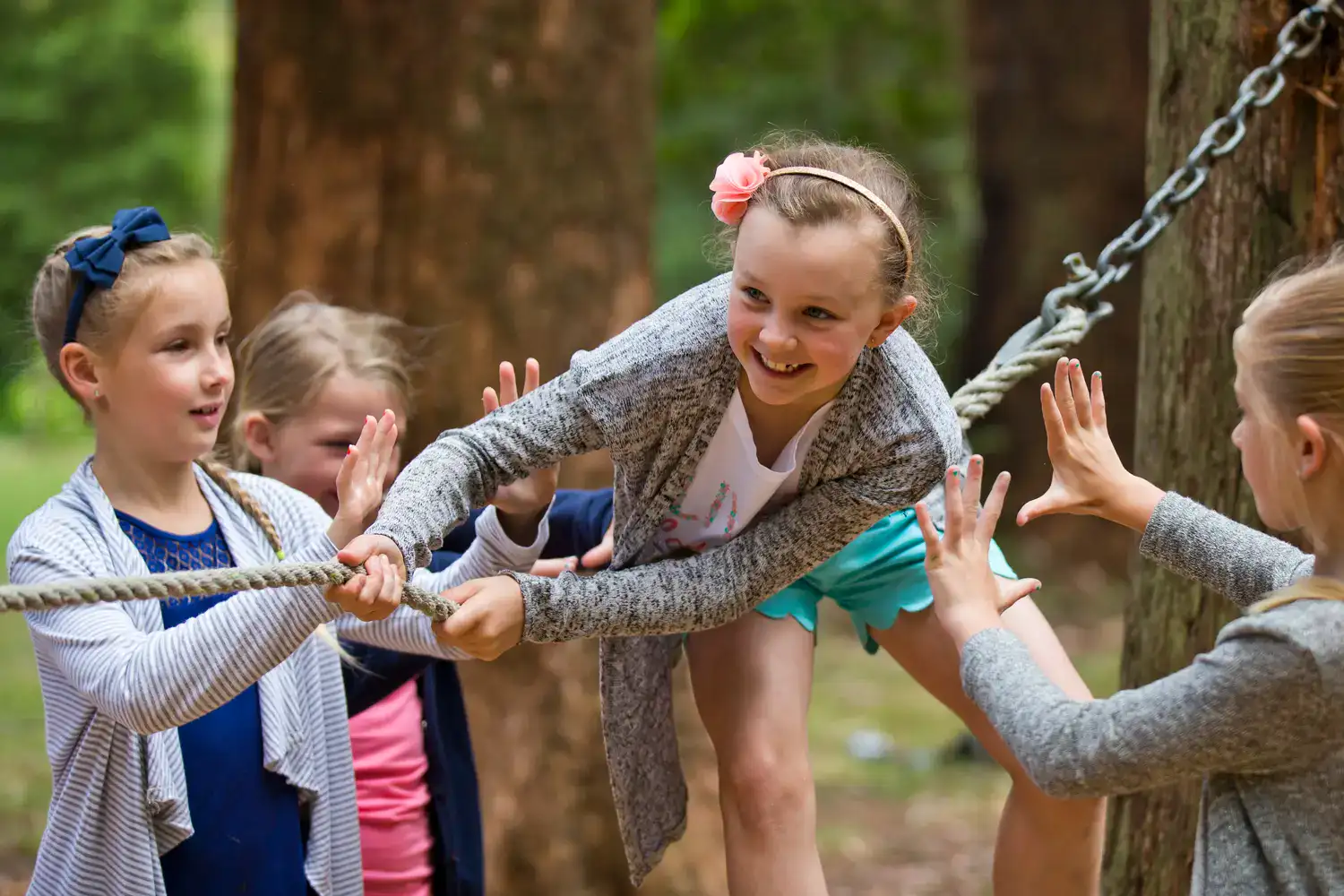
- Low ropes activities on the ground build teamwork and trust between cabin mates before anyone climbs. Trust falls, group balance challenges, and cooperative problem-solving exercises teach children that their peers and counselors will support them. This peer support becomes critical when the child is 25 feet in the air and needs encouragement from below.
- The first climb onto the high ropes platform introduces genuine fear in a controlled dose. The child’s amygdala fires. Her heart rate spikes. Her hands grip the ladder tighter. This is the moment where the ropes course does its work: the child feels the fear, recognizes that she is safe, and makes a conscious choice to continue.
- Navigation through the elements proceeds at the child’s own pace under the “challenge by choice” philosophy. She may complete the cargo net but skip the balance beam. She may cross the rope bridge but decline the leap of faith. Every element she attempts, regardless of how many she completes, adds another data point to her brain’s growing evidence file that she can face something scary and survive.
- The debrief after the session connects the physical experience to its emotional meaning. The facilitator asks the group what they felt, what surprised them, and what they learned about themselves. This reflection transforms the ropes course from a physical activity into a developmental experience that the child can reference the next time she faces something frightening, whether that is a math test, a social situation, or a new activity she has never tried.
The sequence matters. Removing any step weakens the outcome. Safety knowledge reduces irrational fear. Peer support provides encouragement. Graduated exposure prevents overwhelm. The debrief creates meaning. Together, these five components produce the lasting confidence change that research has documented across decades of challenge course studies.
How Does “Challenge by Choice” Work on a Ropes Course?
“Challenge by choice” works on a ropes course by giving every child complete control over how far she pushes herself. No one is forced to climb. No one is shamed for stopping. No one is compared to the child who went higher or moved faster. The child decides her own boundary, and that boundary is respected by staff and peers alike.
This philosophy produces deeper confidence than forced completion because the child owns the decision. A girl who climbs halfway up the cargo net and chooses to stop has still pushed past her starting point. She chose to try. She chose her limit. She chose to step off the ground at all. That ownership transforms the experience from “someone made me do something scary” into “I chose to do something scary, and I survived.” The distinction is psychologically powerful. Research on self-efficacy by Albert Bandura identifies mastery experiences, accomplishments that a person achieves through their own effort, as the single most powerful source of self-confidence. Challenge courses at camp deliver mastery experiences in concentrated form because every element the child attempts is a new opportunity to prove to herself that she is braver than she thought.
What Happens in a Child’s Brain When They Overcome Fear?
When a child overcomes fear on a ropes course, her brain undergoes a measurable neurological shift. The amygdala, which triggered the initial fear response, receives new information: the scary thing happened, and the child survived unharmed. Each safe exposure weakens the association between the stimulus (height, wobbling bridge, open air) and the threat response (panic, freeze, retreat). This process is called fear extinction, and it is one of the most well-studied mechanisms in behavioral neuroscience.
Physical activity during the fear experience accelerates the recalibration. Research cited by Huffington Post reporter Abigail Wise found that physical activity increases levels of norepinephrine, a brain chemical that helps regulate the stress response. Climbing, balancing, and traversing ropes course elements while experiencing fear gives the brain a competing signal: the body is active, engaged, and performing, which counteracts the freeze response that fear typically produces. The result is a child who learns, at a neurological level, that fear does not have to mean stop.
The confidence that emerges after a child completes a ropes course element is not abstract positive thinking. It is a physical, neurological restructuring of how the brain processes threat. The child’s brain now has evidence that she can stand on a high platform and move forward. That evidence does not disappear when she leaves the course. It becomes part of her neural architecture, available the next time she faces something frightening. Research from Cortez and Bugental (1995), cited in Pediatric Nursing, found that children who view fear as a challenge to overcome demonstrate enhanced resilience when dealing with future problems, showing higher self-efficacy and increased effort when faced with obstacles. The ropes course trains a child’s brain to see fear as a signal to engage, not a signal to retreat.
What Are the Benefits of a Ropes Course for Overcoming Fear?
The benefits of a ropes course for overcoming fear extend across physical, emotional, social, and cognitive dimensions. Each benefit reinforces the others, creating a compound effect that makes the ropes course one of the most developmentally powerful activities a camp can offer:
- Physical proof of capability: the child’s body did something her mind said she could not. She climbed. She balanced. She crossed. The evidence is undeniable because she felt it in her muscles, her grip, and her racing heart that gradually slowed as she moved forward.
- Earned self-efficacy: psychologist Albert Bandura’s research identifies mastery experiences as the strongest predictor of future confidence. Every ropes course element a child completes is a mastery experience that builds her belief in her own ability to handle difficulty.
- Emotional regulation under pressure: the child practiced managing a fear response while continuing to function. She breathed, focused, and moved despite shaky hands and a pounding heart. This emotional regulation skill transfers directly to test anxiety, social pressure, and performance situations at school.
- Peer bonding through shared vulnerability: children who cheer each other through frightening moments form bonds that are qualitatively deeper than friendships built on shared hobbies or proximity. The ropes course creates the kind of shared vulnerability that produces lasting camp friendships.
- A reusable mental framework for future challenges: the debrief teaches children to name what they felt, recognize that they pushed through, and apply that pattern to the next scary thing. “I was afraid on the ropes course, and I did it anyway” becomes a template for “I was afraid to raise my hand in class, and I did it anyway.”
The Gillis and Speelman (2008) meta-analysis of 44 challenge course studies found that self-esteem or self-concept was the most frequently measured outcome, appearing in 45.5% of all studies reviewed. The consistent finding across these studies was positive change. Cason and Gillis (1994) reported that adolescents who participated in adventure programming scored better than 62% of adolescents who did not participate. These are not small effects. They represent measurable, documented improvements in how children see themselves and their ability to handle the world.
| Age Range | Common Fears (Stanford Medicine / URMC) | How the Ropes Course Addresses the Fear |
| 6-8 years | Being alone, the dark, animals, loud noises, new situations | Low ropes group activities keep the child surrounded by peers and counselors; no isolation, no darkness, gradual introduction to new challenges |
| 8-10 years | Natural disasters, school performance, being embarrassed, making mistakes | “Challenge by choice” removes performance pressure; mistakes on the course are celebrated as attempts; no grades, no scores, no competition |
| 10-12 years | Heights, older kids, failure, catastrophe, parental anger | High ropes directly address fear of heights through safe graduated exposure; mixed-age encouragement eliminates fear of older kids; accomplishment replaces fear of failure |
| 13-16 years | Social judgment, injury, isolation, public speaking, performance | Shared vulnerability on the course eliminates social judgment; ACCT safety systems prevent injury; peer cheering builds belonging; debrief builds communication confidence |
Sources: Stanford Medicine Children’s Health, University of Rochester Medical Center (URMC), Anxiety Care UK, Association for Challenge Course Technology (ACCT) facilitation standards, American Camp Association (2005).
Can a Child with a Fear of Heights Do a Ropes Course?
Yes, a child with a fear of heights can do a ropes course, and she is often the child who benefits most from the experience. The “challenge by choice” philosophy means no child is ever forced onto any element she does not want to attempt. A girl who is terrified of heights can participate fully in low ropes activities that happen close to the ground, build trust with her cabin mates and counselors, and then decide for herself whether to attempt any high ropes elements at all.
Many children who start the day certain they will never leave the ground end up climbing higher than they imagined possible. The progression is gradual. First, she watches a cabin mate climb and return safely. Then she puts on the harness and stands at the base of the ladder. Then she climbs three rungs and stops. Then five. Then she reaches the first platform and looks down. Each small step adds evidence that the fear, while real, does not match the actual level of danger. The ACA found that 74% of campers did things at camp they were initially afraid to do, and ropes courses are among the most frequently cited activities where children surprise themselves.
We see this pattern every summer. A camper arrives at the high ropes station with wide eyes and crossed arms. By the end of the session, she is grinning from the zip line platform, waiting for her turn to fly. The gap between “I can’t” and “I just did” is where the confidence lives, and the ropes course creates that gap in a way that is safe, supported, and entirely within the child’s control.
How Can Children Overcome Fear Through Camp Activities?
Children can overcome fear through camp activities because camp exposes them to a steady stream of manageable challenges in a supportive environment where trying is celebrated and quitting is not punished. The ropes course is the most dramatic example, but the same fear-to-confidence mechanism operates across the entire camp day.
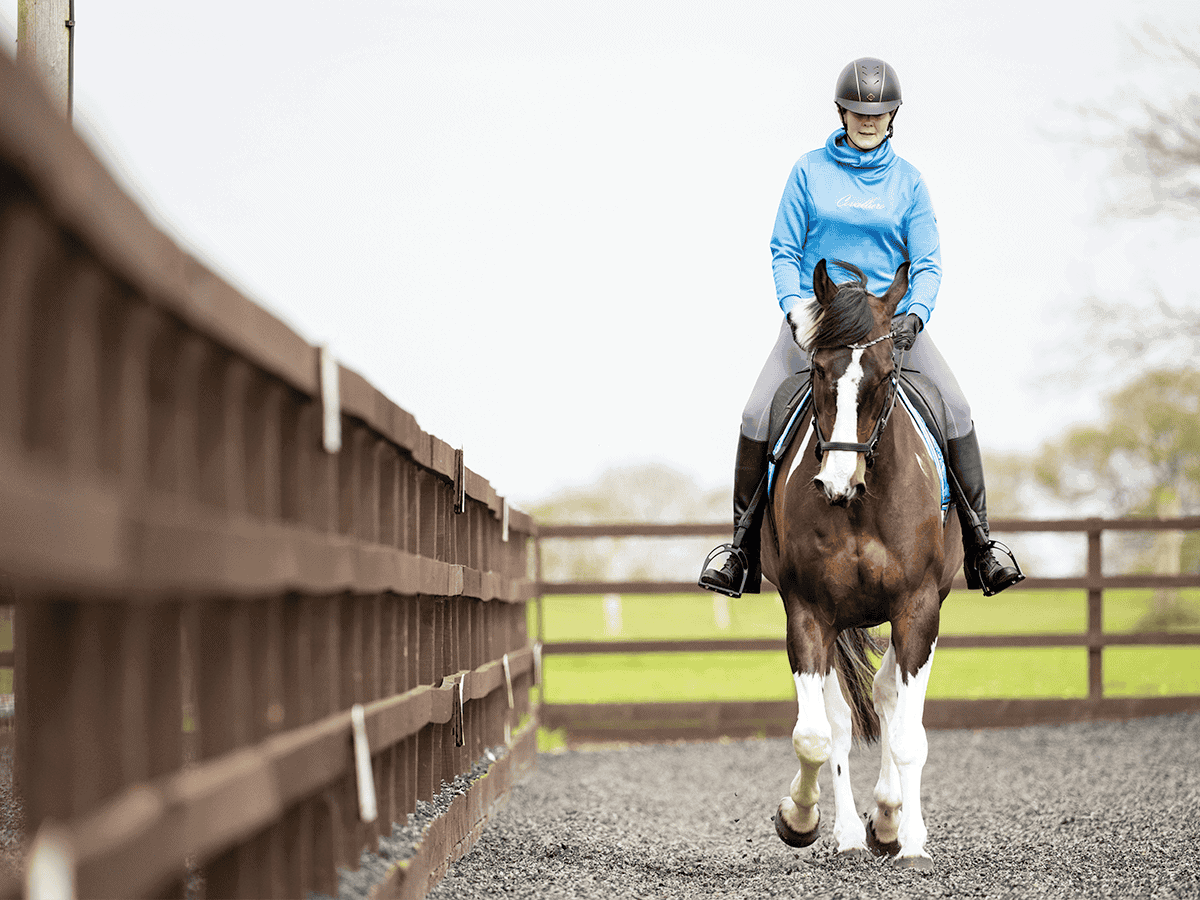
Horseback riding asks a child to trust a 1,000-pound animal she has never met. Swimming asks a child to put her face underwater and trust that her body will float. Archery asks a child to pull back a bowstring and release, trusting her aim. Performing in a talent show asks a child to stand in front of her peers and risk embarrassment. Sleeping away from home for the first time asks a child to trust that she will be safe without her parents nearby.
Each of these experiences follows the same progression the ropes course uses: the child encounters something that triggers a fear response, receives support from staff and peers, makes a choice to try, and discovers that the feared outcome did not happen. The ACA found that 70% of parents reported their child gained self-confidence at camp, and 92% of campers said the people at camp helped them feel good about themselves. These numbers reflect the cumulative effect of dozens of small fear-conquering moments that happen across a one- or two-week session. The ropes course is the flagship, but every camp activity contributes to the same developmental arc. Reviewing what to expect at camp helps parents understand the full range of growth opportunities their daughter will encounter.
Does Overcoming Fear at Camp Help Kids in School?
Yes, overcoming fear at camp helps kids in school because the confidence and emotional regulation skills a child builds on the ropes course and in other camp activities transfer directly into academic and social situations. A child who learned to manage her fear response while standing on a wobbling bridge 25 feet in the air has practiced the exact same skill she needs to manage her anxiety before a math test, a class presentation, or a conversation with a new classmate.
Research from Richmond, Sibthorp, and Wilson (2019) found that 60% of summer camp alumni reported that camp helped develop their independence, teamwork, leadership, and communication skills. These are the same skills that predict academic engagement and social success in school. The ACA’s National Camp Impact Study, which tracked outcomes across five years, found that high-quality camp experiences promote social awareness more than almost any other measurable outcome. Social awareness, the ability to read social cues, empathize with peers, and collaborate effectively, is a foundational skill for classroom participation and peer relationships.
The transfer works because the brain does not distinguish between “courage on the ropes course” and “courage in the classroom.” The neural pathways a child builds when she pushes through fear at camp are the same pathways she activates when she raises her hand to answer a question she is not sure about, tries out for a team she might not make, or introduces herself to a new student at school. Camp provides the training ground. School provides the application. Children who attend ACA-accredited camps receive this training in a structured, professionally facilitated environment designed to maximize the developmental return.
What Is the Difference Between Fear and Anxiety in Children?
The difference between fear and anxiety in children is that fear is a response to a specific, identifiable threat, while anxiety is a generalized sense of worry or dread that is not tied to a particular object or situation. A child who is afraid of the high ropes course has fear: the threat (height) is specific, present, and identifiable. A child who worries for days before camp about “something bad happening” has anxiety: the worry is vague, diffuse, and not connected to a single clear trigger.
Ropes courses primarily address fear, the specific, in-the-moment response to a concrete challenge. The child stands on the platform, feels the fear, and chooses to act despite it. The broader camp environment addresses anxiety by providing routine, belonging, positive adult role models, and a community where the child feels valued and safe. Together, the ropes course and the camp experience create conditions where both fear and anxiety decrease: fear through direct exposure and mastery, anxiety through social connection and predictable structure.
Parents of children with significant anxiety should know that camp programs are designed to support, not overwhelm. Counselors are trained to recognize signs of distress and to help children prepare for camp at a pace that matches their readiness. The “challenge by choice” philosophy applies to every activity, not just the ropes course. No child is ever forced to participate in anything that exceeds her comfort level. The goal is growth, not stress.
Frequently Asked Questions
How Can Parents Help Kids Overcome Their Fears?
Parents can help kids overcome their fears by validating the fear without reinforcing it, providing opportunities for safe exposure, and celebrating effort rather than outcome. Telling a child “there is nothing to be afraid of” dismisses her experience. Telling her “I can see you are scared, and I believe you can do this” validates the emotion while encouraging action. Enrolling a child in a camp with a ropes course program gives her a structured, professionally facilitated opportunity to practice overcoming fear in an environment specifically designed for that purpose.
What If My Child Refuses to Go on the Ropes Course?
If a child refuses to go on the ropes course, the “challenge by choice” philosophy protects her decision. She will not be forced, shamed, or singled out. She can participate in low ropes ground activities, watch her cabin mates, and cheer from below. Many children who refuse on day one attempt the course later in the session after seeing their friends succeed safely. The door stays open. There is no deadline and no pressure.
How Hard Is a Ropes Course for Kids Who Are Scared?
A ropes course is as hard as the child chooses it to be. Elements range from low-to-the-ground balance challenges that require no height tolerance to high ropes elements 25 to 40 feet above the ground. A scared child can start at the easiest level and progress only as far as she feels comfortable. The harness and continuous belay system keep her physically safe at every height. The difficulty is primarily psychological, and the child controls the dosage.
At What Age Can Kids Do a Ropes Course?
Kids can do low ropes activities as young as 5 or 6. High ropes elements typically require children to be at least 7 or 8, depending on the child’s ability to fit a harness properly and follow multi-step safety instructions. The ideal age range for a full camp ropes course experience is 7 to 16. Camp programs adapt the experience to each age group, with younger campers receiving more guidance and simpler elements, and older campers accessing advanced challenges.
Is a Ropes Course Safe for Anxious Children?
Yes, a ropes course is safe for anxious children when operated by trained facilitators following ACCT and ACA standards. The “challenge by choice” model gives anxious children control over their experience, which is itself anxiety-reducing. Continuous belay systems prevent falls. Facilitators monitor every participant and can assist anyone who needs help. Many parents of anxious children report that the ropes course was the activity where their daughter experienced her biggest confidence breakthrough because the structure, safety, and support removed the variables that typically amplify anxiety.
Wrapping It Up
Fear is normal. Fear of heights, fear of failure, fear of looking silly in front of friends, these are experiences every child has. The question is not whether a child will feel fear, but whether she will have the chance to practice pushing through it in a safe, supported environment before the stakes get higher. A ropes course at summer camp gives her that chance. The harness keeps her body safe. The facilitator keeps her experience structured. The “challenge by choice” philosophy keeps her in control. And the moment she steps off the platform, crosses the bridge, or catches the zip line, her brain records a new piece of evidence: she is braver than she thought.
Seventy-four percent of campers did things at camp they were initially afraid to do. Sixty percent of camp alumni carry lasting gains in independence and confidence into adulthood. The ropes course, nestled among the tall pines of Lookout Mountain in Mentone, Alabama, is where many of those breakthroughs begin. Riverview Camp for Girls is ready to help your daughter discover what she is capable of when fear stops being a wall and starts being a door. Enroll today and give her a summer she will carry with her for life.