
Summer camp builds resilience in kids by providing manageable challenges, trusted adult relationships outside the family, a fresh social start, physical development, belonging, and the self-efficacy that comes from succeeding at hard things away from home. Dr. Michael Ungar, a resilience researcher at Dalhousie University and author of multiple books on the subject, identified seven specific factors that camps provide to make children more resilient after speaking with 300 camp directors. The American Camp Association’s landmark research found that 70% of parents reported their child gained self-confidence at camp, 74% of campers did things they were initially afraid to do, and 92% said the people at camp helped them feel good about themselves. A follow-up study by Richmond, Sibthorp, and Wilson (2019) found that 60% of camp alumni reported lasting gains in independence, teamwork, and leadership years after their last summer. This article explains what resilience means, how camp builds each component of it, what the research shows, and why the camp environment produces resilience gains that school and home alone cannot replicate.
What Is Resilience and Why Does It Matter for Kids?
Resilience is a child’s ability to face difficulty, manage discomfort, adapt to change, and recover from setbacks without being overwhelmed. It is not the absence of struggle. It is the capacity to move through struggle and come out stronger on the other side. Resilient children do not avoid hard things. They approach hard things with the belief that they can handle whatever happens, a belief that psychologists call self-efficacy.
Resilience matters because childhood is full of challenges that no parent can remove: a difficult test, a friendship conflict, a move to a new school, a failed tryout, a disappointing grade. Children who have practiced resilience in manageable doses, who have faced something hard, felt uncomfortable, and succeeded anyway, are better equipped to handle these inevitable challenges without shutting down or giving up. Camp provides those manageable doses of difficulty in a structured, supported environment where the stakes are low but the lessons are lasting.
How Does Summer Camp Help Kids Develop Resilience?
Summer camp helps kids develop resilience through seven specific mechanisms identified by Dr. Michael Ungar’s research with 300 camp directors. Each mechanism addresses a different dimension of resilient functioning, and camp delivers all seven simultaneously in a concentrated experience that school and home typically cannot match.
- Camp provides new relationships with trusted adults who are not the child’s parents. A camper who learns to ask her counselor for help, negotiate a conflict with a staff member, or accept guidance from an unfamiliar authority figure is practicing a skill she will need in every classroom, workplace, and community she enters for the rest of her life. Learning to build trust with adults outside the family is a foundational resilience skill.
- Camp builds a powerful identity that makes the child feel confident in front of others. A child may not be the fastest swimmer or the best on the ropes course, but a skilled counselor helps every camper find something she can be proud of. Maybe she discovers she is a natural at archery, or that her cabin mates think she is the funniest person they have ever met, or that she has a gift for encouraging a scared friend on the climbing wall. That discovery becomes a piece of identity she carries home.
- Camp gives children a sense of control over their own lives. When a child manages her own schedule, makes decisions about which activities to try, navigates a disagreement with a cabin mate without parental intervention, and solves problems independently, she experiences self-efficacy. These experiences of competence travel home and make her a better problem-solver in new situations long after camp ends.
- Camp treats every child fairly by offering a fresh start. The child who was labeled “the quiet one” at school arrives at camp with no label at all. The child who struggled socially in her classroom has no reputation to overcome. Camp strips away the social baggage that accumulates over years of school and gives every camper a clean slate. The ACA found that 93% of campers said camp helped them get to know kids who are different from them, a statistic that reflects the openness of the camp social environment.
- Camp develops children physically through fresh air, exercise, balanced nutrition, and a daily rhythm that alternates between structured activity and unstructured free time. Swimming, horseback riding, hiking, canoeing, and outdoor living skills build strength, coordination, and endurance. Physical capability supports emotional resilience because a child who feels strong in her body is more likely to feel strong in her mind.
- Camp creates a sense of belonging. The camp traditions, team chants, cabin songs, campfire rituals, and shared language that develop over a session give every child a community identity that goes beyond proximity. She is not just a girl who happens to be at camp. She is a Riverview girl, a member of her cabin team, a participant in a tradition that stretches back decades. That belonging is a protective factor against isolation and low self-worth, two of the biggest threats to resilience in children.
- Camp gives children a sense of their own values and culture. Through special events, faith programming, service projects, and community discussions, campers explore what they believe, what they value, and how they want to treat other people. A child who understands her own values has an internal compass that guides her through difficult decisions and peer pressure long after the summer ends.
What Are the Benefits of Summer Camp for Kids?
The benefits of summer camp for kids span four developmental categories that collectively build the resilient, well-rounded young person every parent hopes their daughter will become.
| Benefit Category | What Camp Develops | Research Evidence |
| Social | Friendship skills, communication, empathy, conflict resolution, trust, cooperation | 96% of campers made new friends (ACA); 95% reported social skill improvement (Monke, 2014); 93% got to know kids different from them (ACA) |
| Emotional | Self-confidence, self-esteem, emotional regulation, fear management, independence | 70% of parents reported child gained self-confidence (ACA); 92% of campers felt good about themselves (ACA); 74% tried things they were afraid to do (ACA) |
| Physical | Strength, coordination, endurance, outdoor skills, healthy lifestyle habits | WHO recommends 60 min/day of moderate-to-vigorous activity for children; camp delivers full-body physical activity across every session |
| Character / Identity | Values, faith, cultural understanding, sense of purpose, belonging | 60% of alumni report lasting gains in independence, teamwork, and leadership (Richmond, Sibthorp & Wilson, 2019); 3-year post-camp gains maintained (Spielvogel et al., 2022) |
Sources: American Camp Association Youth Development Outcomes Study (2005), ACA National Camp Impact Study (2017-2022), Audrey Monke residential camp study (CSU Fresno, 2014), Richmond, Sibthorp & Wilson (2019), Spielvogel, Warner & Sibthorp (2022), Dr. Michael Ungar (Dalhousie University / Psychology Today).
How Can Parents Help Kids Develop Resilience?
Parents can help kids develop resilience by providing opportunities for manageable difficulty rather than removing every obstacle from their child’s path. Dr. Ungar describes this as “the risk-taker’s advantage”: children who are allowed to face manageable amounts of risk and responsibility develop stronger coping strategies than children who are shielded from discomfort. Camp is one of the most effective ways parents can provide this experience because it places the child in a professionally managed environment where the challenges are real but the safety net is strong.
At home, parents can reinforce the resilience their daughter builds at camp by applying the same principles the camp environment uses:
- Let her solve problems before intervening. A child who works through a disagreement with a sibling, figures out how to organize her school supplies, or recovers from a disappointing grade on her own is practicing the same independent problem-solving she learned at camp.
- Celebrate effort rather than outcome. A child who tried the ropes course and made it halfway has grown more than a child who never stepped on the platform. Apply the same principle at home: praise the attempt, not just the result.
- Talk about setbacks as learning opportunities rather than failures. Camp normalizes struggle as part of growth. Carry that framing into school, sports, and social situations.
- Encourage her to try new things even when she is nervous. The ACA found that 63% of parents reported their child continued new activities learned at camp after returning home, which suggests that camp creates momentum parents can build on.
Preparing your daughter for camp is itself a resilience-building exercise: discussing expectations, practicing time away from home, and packing together all communicate the message “I trust you to handle this.”
Why Is Camp Better at Building Resilience Than School?
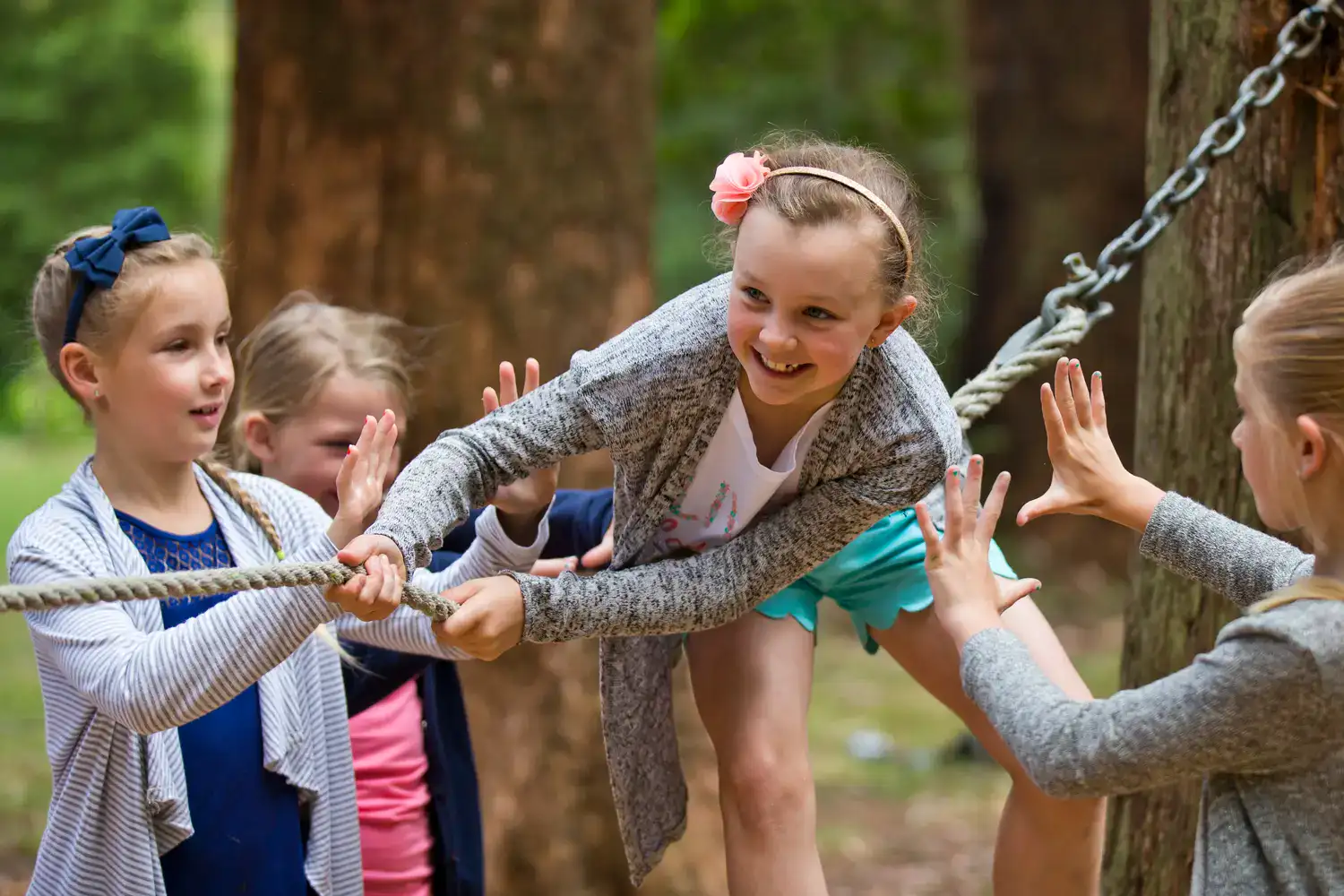
Camp is better at building resilience than school because camp removes the structures that prevent children from facing difficulty independently. At school, a child who struggles with a math problem asks the teacher or goes home and asks a parent. At camp, a child who struggles to light a campfire, cross a rope bridge, or resolve a disagreement with a cabin mate must figure it out herself, with the guidance of a counselor who coaches rather than rescues.
School is organized around academic performance, where failure carries consequences (low grades, parental disappointment, peer comparison). Camp is organized around experience, where failure carries learning. A child who falls off the balance beam on the ropes course clips back in and tries again. A child who misses the archery target adjusts her aim and shoots another arrow. The cost of failure at camp is low, but the reward of persistence is high. This combination, low-cost failure plus high-reward persistence, is the exact formula that resilience research identifies as most effective for building grit, self-efficacy, and emotional regulation in children.
Camp also provides 14 to 16 hours of daily face-to-face social interaction in a screen-free environment. The ACA reports that 97% of accredited camps limit digital devices. A child who cannot text her mother when she feels uncomfortable, scroll social media when she feels bored, or retreat into a screen when she feels socially awkward must use human coping strategies instead: talking to a friend, asking a counselor for help, or sitting with discomfort until it passes. These are the skills that resilience is made of, and camp is one of the few environments left in a child’s life where she has no choice but to practice them. Reviewing what to expect at camp helps parents understand how the screen-free, challenge-rich environment produces the resilience gains the research documents.
Do the Resilience Benefits of Camp Last?
Yes, the resilience benefits of camp last well beyond the summer session. Richmond, Sibthorp, and Wilson (2019) found that 60% of camp alumni reported that camp helped develop their independence, teamwork, leadership, and communication skills, gains that persisted into adulthood. Spielvogel, Warner, and Sibthorp (2022) found that three years after attending camp, children maintained increases in their willingness to try new things and their connection to nature. The ACA’s National Camp Impact Study, which tracked outcomes across five years (2017-2022), found that high-quality camp experiences promote social awareness more than almost any other measurable outcome.
The durability of camp’s resilience benefits is explained by the way the brain processes experience. When a child pushes through a challenge at camp, her brain records the event as evidence of capability. That evidence does not expire. A girl who stood on a zip line platform at age 10, felt terrified, and chose to go anyway carries that data point into every subsequent moment of fear or uncertainty. The ropes course, the first night away from home, the talent show performance, the cabin conflict she resolved on her own: each of these experiences deposits a layer of evidence into her self-concept that says “I can handle hard things.” The cumulative effect of a week or two of these deposits is a measurably more resilient child.
Frequently Asked Questions
What Are the 7 C’s of Resilience for Children?
The 7 C’s of resilience, developed by pediatrician Dr. Kenneth Ginsburg, are competence, confidence, connection, character, contribution, coping, and control. Camp addresses all seven: competence through mastering new activities, confidence through succeeding at challenges, connection through cabin friendships and counselor relationships, character through values-based community living, contribution through service and teamwork, coping through managing homesickness and fear, and control through making independent decisions throughout the day.
Is 14 Too Old for Summer Camp?
No, 14 is not too old for summer camp. Many camps offer programming specifically designed for teens ages 13 to 16, including leadership tracks, CIT (Counselor-in-Training) programs, and advanced activity options. The resilience benefits of camp are especially valuable during the early teen years, when self-consciousness, social pressure, and identity formation are at their peak. A 14-year-old who spends two weeks in a supportive, screen-free community practicing independence and leadership returns to school with social and emotional tools that most of her peers have not had the opportunity to develop.
At What Age Do Kids Stop Going to Summer Camp?
Most campers attend camp between the ages of 7 and 16, with many camps offering CIT or leadership programs for 15- and 16-year-olds. Some camps also offer junior counselor or staff-in-training programs for 17-year-olds. The “right” age to stop attending camp varies by family, but many camp alumni report that their final summer as a camper or CIT was one of the most formative experiences of their adolescence. ACA-accredited camps design programming for each age group so that every summer offers new challenges and deeper growth, even for returning campers.
Can Camp Help a Child Who Is Already Struggling Emotionally?
Camp can be a powerful support for children who are struggling with low confidence, social difficulty, or mild anxiety. The fresh-start social environment, the screen-free setting, the daily physical activity, and the supportive counselor relationships address many of the factors that contribute to emotional difficulty in children. Camp is not therapy and should not replace professional support when a child needs it, but the resilience-building mechanisms that camp provides, belonging, self-efficacy, trusted adult relationships, and manageable challenge, are the same factors that clinical research identifies as protective against emotional difficulty.
How Do I Know If My Child Is Building Resilience at Camp?
You will know your child is building resilience at camp when she comes home and handles a problem she used to avoid, attempts an activity she used to refuse, recovers from a disappointment faster than she did before camp, or describes a difficult moment at camp with pride rather than distress. The signs are behavioral, not verbal. A resilient child does not announce “I am resilient now.” She shows it by doing things she could not or would not do before. If your daughter comes home and starts making her own breakfast, resolving a sibling argument without parental intervention, or signing up for a new activity at school, camp did its job.
The Lasting Gift
Resilience is not something a parent can give a child through words. It is something a child builds through experience. Camp provides the experiences: the manageable challenges, the trusted relationships, the belonging, the physical demands, the social navigation, and the quiet moments of self-discovery that accumulate into the belief that “I can handle hard things.” That belief is the foundation of resilience, and it is the most lasting gift a summer at camp can give.
On the banks of Little River in Mentone, Alabama, Riverview Camp for Girls has been building resilient young women since 1924. Enroll your daughter and give her a summer that builds not just memories, but the strength to carry them forward into everything that comes next.