Choosing between English and Western riding depends on your goals. Western riding offers more immediate security for beginners because the saddle is larger, the seat is deeper, and riders hold the reins in one hand while the horse responds to neck-rein pressure. English riding builds a more versatile foundation in balance, posture, and precise communication with the horse because the saddle is smaller and flatter, riders hold the reins in both hands with direct contact to the horse’s mouth, and the gaits require active participation from the rider, including posting (rising and sitting in rhythm) at the trot. Western riding is best for trail riding, casual riding, and ranch-style disciplines. English riding is best for building core balance and body control, and it opens pathways toward jumping and dressage. Most riding instructors agree that a rider who learns English first can transition to Western more easily than the other way around, because English riding develops a stronger independent seat from the start.
What Is the Difference Between English Riding and Western Riding?
The difference between English riding and Western riding comes down to the saddle, the rein technique, the gaits, and the purpose each style was designed to serve. English riding originated from European military cavalry training, where precision, posture, and clear communication between horse and rider determined survival in battle. Western riding developed on the cattle ranches of the American West, where cowboys needed to stay secure in the saddle for long hours, control the horse with one hand, and keep the other hand free to rope livestock. Those two origins shaped every aspect of how each style looks, feels, and functions today.
Both styles share the same fundamental goal: effective communication between horse and rider. Both require balance, body awareness, and respect for the horse. Both develop confidence, responsibility, and physical fitness. The differences lie in the equipment used, the specific techniques taught, and the disciplines each style leads toward. A study published in the Journal of Physical Therapy Science found that regular horseback riding increases trunk strength and balance in riders regardless of discipline, confirming that the physical benefits apply to both English and Western instruction.
What Is English Riding?
English riding is a style of horseback riding that uses a smaller, lighter saddle without a horn, requires riders to hold the reins in both hands for direct contact with the horse’s mouth, and emphasizes precise body position, balance, and active participation in every gait. The English saddle is designed to keep the rider close to the horse’s back, which allows for more direct communication through weight shifts, leg pressure, and rein contact. English riders feel more of the horse’s movement underneath them, which develops a stronger sense of balance and a more independent seat over time.
The gaits in English riding include the walk, the trot, and the canter. The trot is where English riding differs most noticeably from Western riding. English riders “post” to the trot, which means they rise out of the saddle and sit back down in rhythm with the horse’s two-beat diagonal leg movement. Posting the trot requires core engagement, leg strength, and timing. The canter in English riding is a smooth three-beat gait where the rider sits deep in the saddle and follows the horse’s rocking motion with their hips. Advanced English riders progress into jumping, where the rider shifts their weight forward over the horse’s neck as the horse clears a fence.
English riding includes several competitive disciplines:
- Dressage: precise movements and transitions that showcase the horse’s training and the rider’s subtle communication. Dressage is one of the three Olympic equestrian disciplines.
- Show jumping: timed courses over fences that test the horse’s athleticism and the rider’s accuracy. Show jumping is also an Olympic discipline.
- Eventing: a three-phase competition combining dressage, cross-country jumping, and show jumping. Eventing is the third Olympic equestrian discipline.
- Hunter riding: judged on the horse’s form, movement, and manners over fences, with an emphasis on smooth, even performance.
- Equitation: judged on the rider’s position, form, and effectiveness rather than the horse’s performance.
English riding is the style promoted by youth organizations like the United States Pony Club, and it is the foundation for all three Olympic equestrian events. The versatility of English riding, from flatwork to jumping to trail riding, makes it the style most commonly taught in structured lesson programs and summer camp life settings where skill progression is the primary goal.
What Is Western Riding?
Western riding is a style of horseback riding that uses a larger, heavier saddle with a horn, requires riders to hold the reins loosely in one hand using neck-rein technique, and emphasizes stability, comfort, and practical horsemanship for trail riding and ranch work. The Western saddle distributes the rider’s weight across a larger surface area of the horse’s back, which makes it more comfortable for extended periods in the saddle. The horn at the front of the saddle was originally designed for securing a lasso when roping cattle, though recreational Western riders do not use the horn for roping.
The gaits in Western riding carry different names and produce a slightly different feel than their English counterparts. The Western walk is the same four-beat gait as the English walk. The jog is the Western equivalent of the trot, but it is typically slower and smoother, allowing the rider to sit without posting. The lope is the Western equivalent of the canter, performed at a relaxed, collected pace. Western riders sit deep in the saddle through all three gaits, which is one reason the style feels more immediately secure to beginners.
Western riding includes its own competitive disciplines. Reining showcases sliding stops, spins, and precise patterns at speed. Barrel racing tests the horse and rider’s ability to navigate a cloverleaf pattern of three barrels as fast as possible. Cutting requires the horse to separate a single cow from a herd and prevent it from returning. Western pleasure is judged on the horse’s quality of movement, manners, and willingness at all three gaits. Trail classes test the horse’s ability to navigate obstacles like gates, bridges, and logs calmly and precisely.
Western riding is the most common style offered at guest ranches, trail riding outfitters, and recreational riding facilities in the United States. The relaxed pace and the security of the deeper saddle make Western riding a natural fit for scenic trail rides where the goal is enjoying the outdoors rather than developing technical riding skills.
How Do English and Western Riding Compare Side by Side?
English and Western riding differ across every major dimension of equipment, technique, and purpose. The Ariat equestrian resource notes that both styles focus on the bond between rider and horse, but English riding disciplines are rooted in sport and precision while Western riding disciplines reflect the practical challenges of the cowboy lifestyle. The following comparison, informed by the consensus descriptions from the U.S. Pony Club, the American Quarter Horse Association, and the United States Equestrian Federation, outlines the key differences beginners should understand.
| Feature | English Riding | Western Riding |
|---|---|---|
| Saddle | Small, flat, lightweight (10-25 lbs), no horn; designed for close contact with the horse | Large, heavy (25-50 lbs), includes a horn; designed to distribute weight for long rides |
| Reins | Held in both hands with direct contact to the bit through the reins | Held loosely in one hand; horse responds to neck-rein pressure on the neck |
| Gaits | Walk, trot (with posting), canter; active rider participation at every gait | Walk, jog (seated), lope; rider sits deep through all gaits |
| Origin | European military cavalry and competitive sport | American West cattle ranching and ranch work |
| Best For | Building core balance, posture, and precision; pathways to jumping and dressage | Trail riding, casual riding, ranch-style work and competition |
| Olympic Disciplines | Dressage, show jumping, eventing (all three Olympic equestrian events) | None currently; reining has been demonstrated at the World Equestrian Games |
| Beginner Feel | Less immediately secure; requires more active balance from the start | More immediately secure; deeper seat and larger saddle provide stability |
| Transferability | English riders transition to Western easily | Western riders transitioning to English need to rebuild balance and rein skills |
Is It Better to Learn English or Western Riding First?
It is generally better to learn English riding first, because English riding develops a stronger independent seat, better balance, and more precise rein skills that transfer directly to Western riding if you switch later. This is the consensus among most riding instructors who teach both disciplines. The smaller English saddle forces the rider to develop balance through core strength rather than relying on the saddle’s structure for support. The two-handed rein contact in English riding teaches the rider to communicate with the horse through subtle, direct cues rather than the looser neck-rein technique used in Western riding.
A rider who starts in English and later tries Western typically feels immediately comfortable in the larger saddle because the balance and body awareness are already ingrained. A rider who starts in Western and later tries English often struggles with the smaller saddle, the two-handed rein technique, and posting the trot, because those skills were never developed in the Western foundation. According to researchers at Penn State University’s Equine Extension program, a strong core is a key component for developing a stable, effective riding position, and English riding develops that core strength from the very first lesson through posting, two-point position, and flatwork exercises.
The exception is a rider whose sole goal is casual trail riding. A rider who plans to ride Western on trails for recreation and has no interest in jumping, dressage, or transitioning to English will do perfectly well starting in Western. The style matches the goal, and the deeper saddle provides the comfort and security a trail rider needs. The “learn English first” advice applies most strongly to riders who want versatility, who may want to try different disciplines later, or who are building a foundation at a young age when transferability matters most.
Is Western Riding Easier Than English Riding?
Western riding feels easier at the beginning because the larger saddle provides more physical security and the seated gaits require less active technique from the rider. A first-time rider in a Western saddle can walk and jog comfortably within the first lesson because the deep seat and wide stirrups create natural stability. A first-time rider in an English saddle must work harder to maintain balance at the walk and will need several lessons before posting the trot feels natural.
“Easier” at the start does not mean easier overall. Western riding at competitive levels demands the same dedication, skill, and years of training that English riding requires. A reining pattern at full speed requires extraordinary body control and timing. Cutting cattle requires split-second reflexes and a deep partnership between horse and rider. The difference is in the entry point: Western riding has a gentler learning curve for the first few weeks, while English riding asks more of the rider’s body from day one. Over months and years of training, both styles demand equal commitment and produce equally skilled horsemen and horsewomen.
Why Do Camps Teach English Riding?
Camps teach English riding because it builds the broadest foundation of riding skills in the shortest time, develops core strength and balance that benefit every physical activity, and provides a clear progression pathway from beginner walk-trot work through cantering, jumping, and advanced flatwork. A summer camp session lasts one to two weeks for most campers, which means the instruction must produce measurable skill development in a compressed timeframe. English riding delivers that progression efficiently because each lesson introduces a new physical challenge that builds directly on the previous one.
We teach English riding classes in walk, trot, canter, and jumping in two oval rings. Our campers select horseback riding as one of their six daily activities and ride every day for their session. That daily repetition, combined with the structured progression of English instruction, means a camper who arrives unable to post the trot can be cantering by the end of a two-week session. The typical English riding progression for a beginner at camp follows this sequence:
- Mounting, dismounting, and basic position at the halt. The rider learns to sit tall, keep heels down, and hold the reins with a soft, even contact.
- Walking independently with steering and halting. The rider practices turning, circling, and stopping using leg and rein cues together.
- Posting the trot. The rider learns the rising-and-sitting rhythm that makes the trot comfortable and builds core strength with every stride.
- Sitting the trot and transitioning between gaits. The rider develops the ability to absorb the horse’s movement through her core and move smoothly from walk to trot and back.
- Cantering. The rider learns the three-beat rocking gait that requires a relaxed seat and confident rein contact.
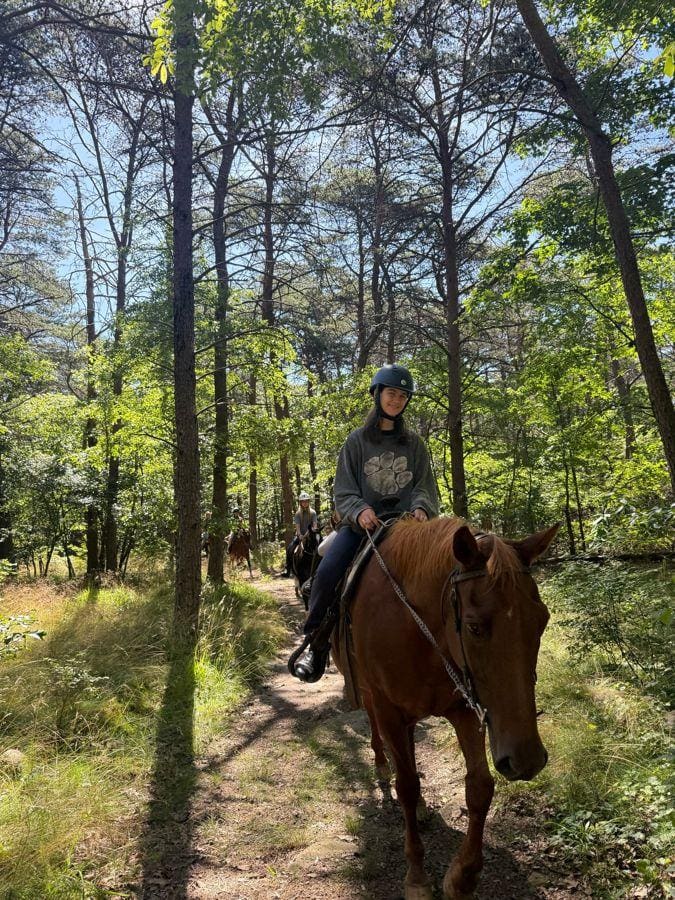
- Introductory jumping and trail riding. Advanced beginners begin small crossrail jumps in the ring and supervised trail rides through scenic forest paths.
That skill arc from walk to canter to introductory jumping gives campers a visible sense of accomplishment that reinforces their confidence. Research from the ACA Youth Outcomes Study found that 70% of parents report their children gained self-confidence at camp, and the progressive challenge structure of English riding contributes directly to that outcome. Older campers who master the progression sometimes continue into our counselors in training program, where riding becomes part of a broader leadership development experience.
English riding also builds physical fitness that transfers to every other activity at camp. The core engagement required for posting, the leg strength developed through two-point position, and the balance demanded by the smaller saddle all strengthen muscles that a camper uses on the ropes course, in swimming, and during canoeing. A study published in Frontiers in Public Health by Tokyo University of Agriculture found that horseback riding improves children’s ability to perform Go/No-go tasks and solve arithmetic problems, likely through activation of the sympathetic nervous system. English riding, with its higher demand for active rider participation, maximizes that cognitive activation because the rider’s brain is processing balance, timing, and rein communication simultaneously throughout every gait.
What Are the Benefits of English Riding for Beginners?
The benefits of English riding for beginners include faster development of core strength and balance, a more versatile skill set that transfers to Western riding and other physical activities, and access to the widest range of competitive and recreational disciplines. English riding asks more of the body from the very first lesson, which means the physical benefits accumulate faster than they do in the seated Western gaits.
A 2023 study published in ScienceDirect found that eight weeks of horseback riding training significantly increased core muscle strength, core endurance, upper and lower extremity strength, and balance in healthy adolescents. English riding’s emphasis on posting, two-point position, and active weight distribution intensifies those physical demands, producing measurable improvements in the rider’s posture, coordination, and trunk stability. For children and teens, those benefits carry beyond the riding ring into school sports, dance, gymnastics, and everyday physical confidence.
The transferability of English riding skills is another major benefit for beginners. A rider with a solid English foundation can sit in a Western saddle and feel at home almost immediately because the balance, body awareness, and leg position are already established. The reverse is harder: a Western-only rider switching to English needs to rebuild their sense of balance without the support of the larger saddle, learn an entirely new rein technique, and develop the posting rhythm from scratch. For young riders who may explore different disciplines, try riding at different facilities, or attend riding programs that vary in style, starting with English provides the broadest base of applicable skills.
What Equipment Do You Need for English vs Western Riding?
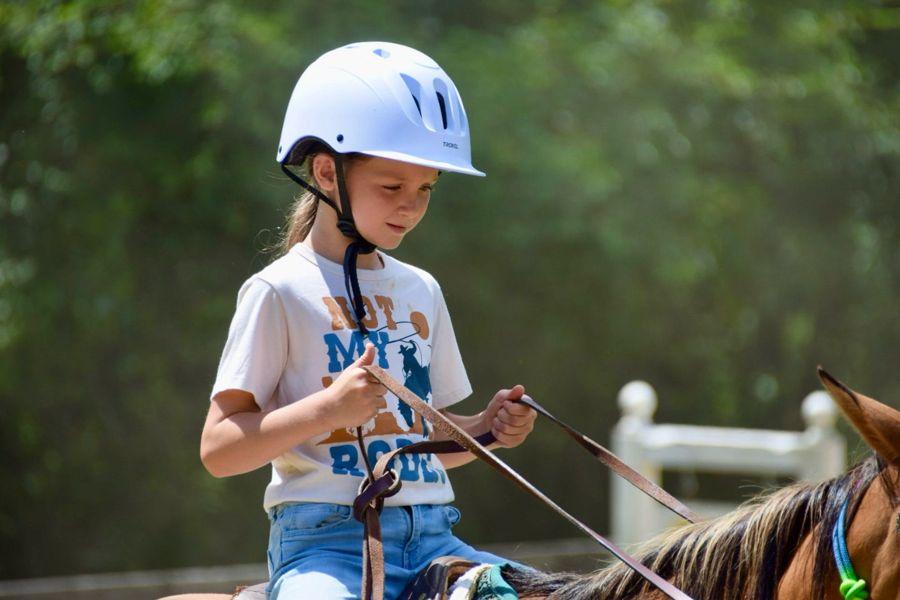
English riding requires an English saddle, a snaffle bridle with two reins, a helmet, breeches or riding pants, and tall boots or paddock boots with half chaps. Western riding requires a Western saddle, a curb bridle with split or loop reins, a helmet (recommended), jeans, and cowboy boots. For beginners taking lessons at a barn or camp, the program provides the saddle, bridle, and helmet. The rider needs to bring appropriate clothing and footwear.
The minimum gear a beginner needs for a first English riding lesson includes long pants that fit snugly (to prevent chafing against the saddle), a shirt that stays tucked in, and boots or hard-soled shoes with at least a one-inch heel. The heel prevents the foot from sliding through the stirrup. An ASTM/SEI-certified equestrian helmet is required for all mounted English riding activities. The American Medical Equestrian Association reports that approved helmets reduce all riding-related head injuries by 30% and severe head injuries by 50%. Most lesson programs and camps provide helmets for beginners. Our packing list specifies the exact footwear and clothing requirements for riding at camp.
Western riders need essentially the same protective gear: a helmet (many Western programs now require helmets for youth riders), long pants (jeans are standard), and boots with a heel. The Western boot has a higher, angled heel and a smooth sole designed for easy entry and exit from the wider Western stirrup. The equipment differences between the two styles are primarily in what the horse wears (saddle and bridle type), not in what the rider wears for safety.
Can You Switch From English to Western Riding?
Yes, you can switch from English to Western riding, and the transition is generally smooth because the balance, body awareness, and communication skills developed in English riding transfer directly to the Western saddle. Riders who start English and switch to Western typically need to adjust to the looser rein contact, the neck-rein technique, and the deeper seat, but those adjustments happen quickly because the rider’s core balance and independent seat are already established.
Switching from Western to English is more challenging. The English saddle provides less physical support, which means a Western-trained rider may feel unstable at first. Posting the trot, holding the reins in two hands, and maintaining a lighter, more forward seat position all require new muscle memory that takes weeks or months to develop. Many riders who have experience in both styles describe the transition from Western to English as “learning to ride all over again,” while the transition from English to Western feels like “relaxing into a bigger chair.”
The ability to ride both styles is valuable. A rider who can switch between English and Western saddles can enjoy trail rides at a guest ranch on vacation, take dressage lessons at home, enter a Western pleasure class at a local show, and jump a course at a schooling competition. That versatility starts with whichever style the rider learns first, but it develops most naturally from an English foundation.
Frequently Asked Questions
Which Is Harder, Western or English Riding?
English riding is harder at the beginner level because the smaller saddle provides less stability and the gaits require active participation from the rider, including posting the trot. Western riding feels easier initially because the larger saddle and seated gaits create natural security. At advanced levels, both styles are equally demanding and require years of dedicated practice to master.
What Does Posting the Trot Mean?
Posting the trot means rising out of the saddle and sitting back down in rhythm with the horse’s two-beat trot. The rider rises as one diagonal pair of the horse’s legs moves forward and sits as the other pair moves forward. Posting reduces the bouncing that occurs at the trot and is more comfortable for both the horse and the rider over extended periods. Learning to post is one of the first skills taught in English riding lessons.
Do More People Ride English or Western?
In the United States, Western riding is more common among recreational riders because of its roots in American ranching culture and its prevalence at trail riding facilities and guest ranches. English riding is more common in competitive and lesson-based settings, and it is the style used in all three Olympic equestrian disciplines. Globally, English riding is the more widely practiced style.
Can a Western Horse Be Ridden English?
Yes, a Western-trained horse can be ridden in an English saddle, though the horse may need some adjustment to the different rein contact and leg cues. Many horses are trained in both disciplines and switch between English and Western tack without difficulty. The horse’s temperament and training matter more than its breed when determining suitability for either style.
What Age Is Best to Start Horse Riding Lessons?
Most children can start formal riding lessons between ages 6 and 8 for either English or Western instruction. Children as young as 2 to 3 can participate in supervised pony rides and introductory groundwork. Readiness depends on the child’s attention span, physical coordination, and comfort around horses. We cover this topic in detail in our guide on what age a child can start horseback riding lessons.
How Long Does It Take to Learn English Riding vs Western?
A beginner can walk and steer confidently in a Western saddle within 1 to 3 lessons. A beginner in English riding typically needs 4 to 8 lessons to feel comfortable at the walk and posting trot. Cantering in either style usually takes several months of weekly lessons. Mastery of either discipline, including competitive readiness, takes years of consistent practice. Daily riding at camp compresses the learning timeline significantly because the repetition builds muscle memory faster than weekly lessons.
The Bottom Line
Neither English nor Western riding is better than the other. They serve different purposes, feel different in the saddle, and lead to different disciplines. For a beginner who wants the broadest foundation, the most transferable skills, and the clearest progression pathway from walk to trot to canter to jumping, English riding provides the strongest starting point. For a beginner whose primary goal is relaxed trail riding and outdoor enjoyment, Western riding offers immediate comfort and security.
We teach English riding at Riverview Camp for Girls because it gives our campers the best foundation for skill development, physical fitness, and the confidence that comes from mastering something challenging. Girls who ride daily at camp on Lookout Mountain in Mentone, Alabama progress from their first walk around the ring to cantering and introductory jumping over the course of a session. That visible progression, earned through effort and practice, is one of the reasons horseback riding is among the most popular activities we offer. You can enroll today or call us at 256-634-4043 to learn more about our riding program and session options.