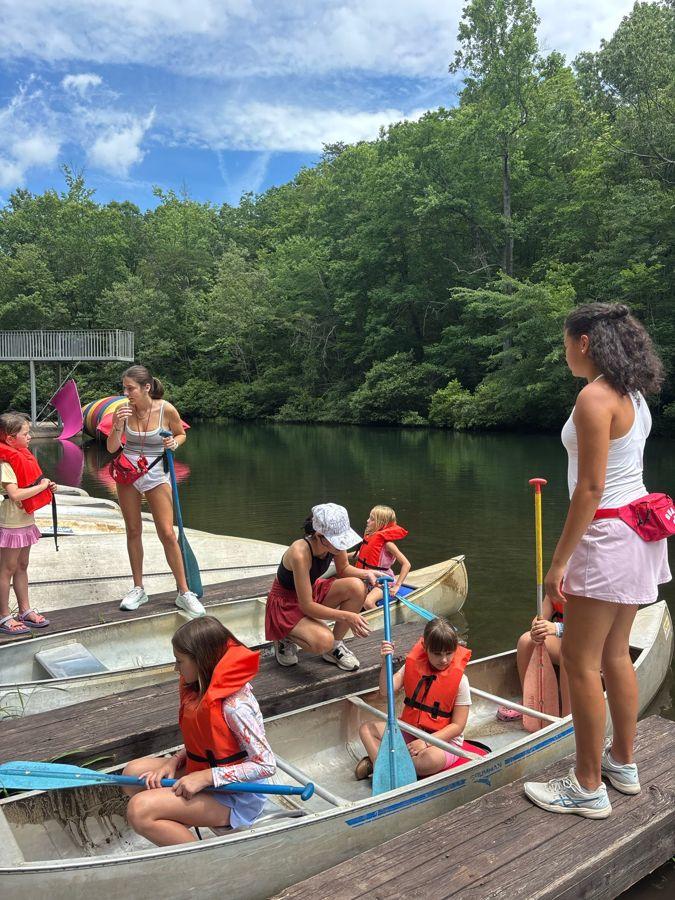
Canoeing gives kids a powerful combination of physical exercise, teamwork, and quiet time in nature that few other activities can match. Paddling a canoe builds upper body and core strength, teaches coordination and balance, develops problem-solving and communication skills, and connects children to the natural world in a way that screens and classrooms cannot replicate. Research from the American Camp Association shows that 76% of campers report learning something new at camp, and canoeing is one of the activities that delivers the broadest range of physical, mental, and emotional benefits in a single experience. Federal health data shows that only 19 to 24% of children ages 6 to 17 get the recommended 60 minutes of daily physical activity, and canoeing addresses that gap while teaching life skills that transfer directly into school, friendships, and personal growth. This article explains each benefit of canoeing for kids, what they learn on the water, and why paddling is one of the most valuable activities a camp can offer.
What Are the Benefits of Canoeing for Kids?
The benefits of canoeing for kids fall into three categories: physical and health benefits, life skills development, and connection with nature. Each category reinforces the others, which is why canoeing produces a broader developmental impact than most youth activities. A girl who builds core strength from paddling also builds the confidence that comes from physical competence. A girl who learns to communicate with her paddling partner also learns the teamwork skills she needs in group projects and friendships. A girl who observes wildlife from a canoe develops environmental awareness that stays with her long after she steps off the water.
The American Camp Association reports that 92% of campers say camp helped them feel good about themselves, and water activities like canoeing contribute directly to that number. Canoeing is one of the few youth activities that simultaneously engages the upper body, core, and cardiovascular system while teaching teamwork, decision-making, and environmental stewardship. The combination of physical challenge and skill development in a natural setting makes canoeing an experience that shapes kids in ways that organized sports and classroom instruction often miss.
What Physical Skills Does Canoeing Develop in Children?
Canoeing develops upper body strength, core stability, coordination, cardiovascular fitness, and balance in children through the continuous physical demands of paddling, steering, and maintaining posture in a moving boat. Every paddle stroke engages the arms, back, shoulders, chest, and core simultaneously, making canoeing a full-body workout that children experience as adventure rather than exercise.
The upper body engagement during paddling is constant and bilateral. Each stroke requires a girl to reach forward, plant the paddle blade in the water, pull it back through resistance, and recover for the next stroke. This motion strengthens the shoulders, biceps, triceps, and upper back through natural resistance rather than through repetitive gym movements. Research from Ontario Parks confirms that paddling increases muscle strength in the back, arms, shoulders, and chest from moving the paddle against the water’s natural resistance.
Core engagement during canoeing is continuous because every paddle stroke involves torso rotation. A girl who paddles on the right side rotates her torso to the right, engages her obliques, and stabilizes through her lower back and abdominal muscles. The constant need to maintain balance in a canoe that tilts and rocks with each stroke, each wave, and each shift in weight activates the deep stabilizing muscles that traditional exercises often miss. Data from multiple paddling health sources confirms that canoeing burns 300 to 500 calories per hour depending on intensity and body weight, making it a more effective cardiovascular workout than many land-based activities children participate in. Swimming builds similar cardiovascular fitness, and girls who participate in both canoeing and swimming develop well-rounded physical strength that supports confidence across every other activity they try.
| Physical Benefit | Canoeing | Swimming | Team Sports | Hiking |
|---|---|---|---|---|
| Upper Body Strength | Very high: continuous paddle resistance | High: full-body propulsion | Moderate: varies by sport | Low: primarily lower body |
| Core Stability | Very high: constant rotation and balance | High: streamlining and rotation | Moderate: varies by sport | Moderate: balance on terrain |
| Coordination | High: bilateral paddle strokes and steering | High: stroke timing and breathing | High: hand-eye and team coordination | Moderate: trail navigation |
| Cardiovascular Fitness | Moderate to high: 300-500 cal/hour | High: full-body aerobic | High: running and movement | Moderate: sustained effort |
| Nature Connection | Very high: immersed in water environment | Low to moderate: pool vs open water | Low: typically on fields or courts | Very high: trail immersion |
| Teamwork | Very high: tandem paddling requires sync | Low: primarily individual | Very high: team coordination | Moderate: group navigation |
Canoeing stands out in the comparison above because it scores high across nearly every dimension simultaneously. Team sports develop coordination and teamwork but rarely build the nature connection or upper body engagement that paddling provides. Hiking connects children with nature but does not develop the upper body strength or the tandem teamwork that canoeing requires. The breadth of physical development that canoeing delivers in a single activity is what makes it so valuable for growing children.
How Does Canoeing Teach Kids Teamwork?
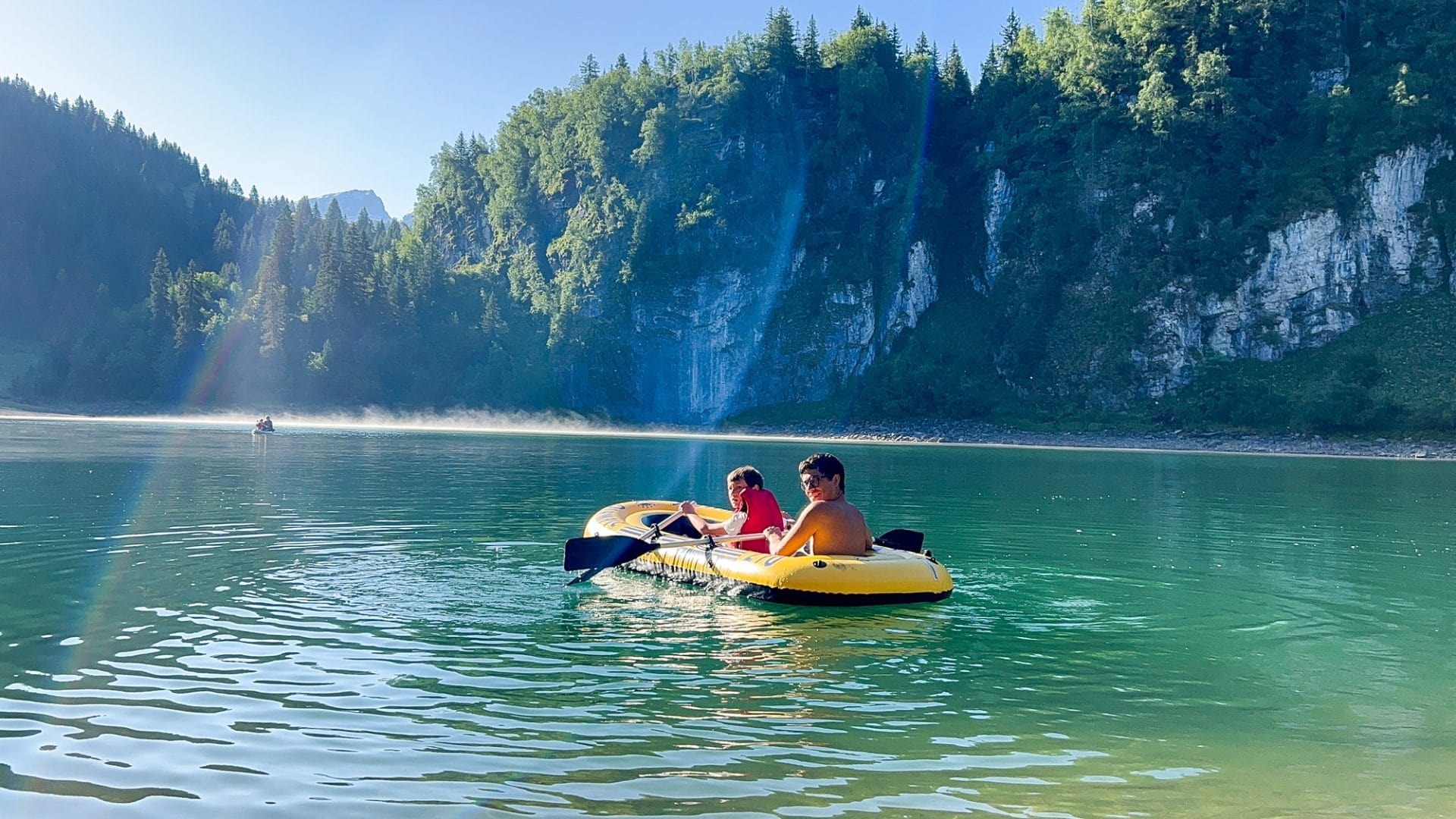
Canoeing teaches kids teamwork because a tandem canoe requires two paddlers to synchronize their strokes, communicate clearly, and make shared decisions in real time to keep the boat moving in the right direction. A canoe that is paddled by two people who are not working together will spin in circles, drift sideways, or stall, and that immediate physical feedback teaches the value of cooperation more effectively than any classroom lesson on teamwork.
The person in the stern (the back seat) steers while the person in the bow (the front seat) provides power and watches for obstacles. Both paddlers must communicate about pace, direction, and hazards. “Rock on the left.” “Slow down.” “Switch sides.” These short, clear instructions are the same kind of direct communication that effective teams use in every setting. A girl who learns to call out obstacles from the bow of a canoe is practicing the same communication skill she will need when leading a group project, directing a team activity, or coordinating with a partner in any professional context. Our canoeing program pairs campers together specifically to develop this kind of synchronized communication.
The teamwork in canoeing is also physical, not just verbal. Two paddlers must match their stroke rate and pressure to keep the canoe tracking straight. A girl who paddles too hard on one side without adjusting will push the boat off course, and her partner must compensate. Learning to feel the rhythm of a partner’s paddling and adjust your own effort accordingly teaches a kind of physical empathy that builds trust and connection faster than most team activities. The ropes course builds similar trust through physical challenge, and girls who experience both canoeing and ropes develop a deep understanding of what it means to rely on and support the people around them.
How Does Canoeing Build Confidence in Kids?
Canoeing builds confidence in kids because it gives them control over their own movement through an environment that is unfamiliar, unpredictable, and genuinely challenging. A girl who paddles a canoe across a river, navigates around a bend, and returns safely to the dock has accomplished something real, and that accomplishment produces a kind of self-trust that no amount of verbal encouragement can replicate.
The confidence-building mechanism in canoeing follows a progression from uncertainty to mastery. A first-time paddler grips her paddle nervously, struggles with her stroke rhythm, and wobbles as the canoe rocks beneath her. By the end of her first session, she has learned how to hold the paddle, how to plant her stroke, and how to sit with the movement of the boat rather than fighting it. By her second or third session, she is steering confidently, calling out directions to her partner, and paddling through conditions that would have scared her on day one. The ACA reports that 70% of parents say their child gained self-confidence at camp, and canoeing is one of the activities most often cited by girls as the experience where they first realized they were more capable than they thought.
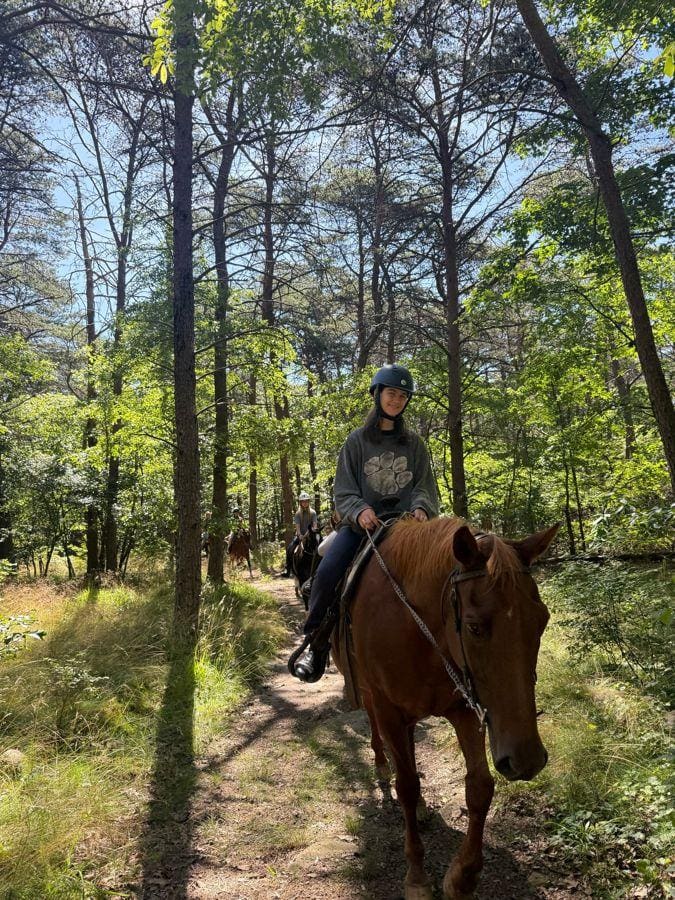
Problem-solving is woven into every moment on the water. A girl must decide how to navigate around a fallen branch, how to adjust her approach when the wind shifts, how to recover when her canoe drifts off course. Each decision is immediate, consequential, and entirely hers. Horseback riding builds similar decision-making confidence, and girls who experience both riding and canoeing develop a broad foundation of self-trust that extends into every area of their lives.
What Do Kids Learn About Water Safety from Canoeing?
Kids learn about water safety from canoeing by practicing real safety protocols in real conditions rather than memorizing rules from a handbook. Every canoeing session begins with a safety briefing that covers life jacket use, proper boarding technique, what to do if the canoe tips, and how to read the water for currents, wind, and obstacles.
The safety skills that canoeing teaches include:
- Wearing a properly fitted life jacket every time they are on or near the water, reinforcing the habit through repetition until it becomes automatic.
- Entering and exiting a canoe safely by keeping their weight low and centered, which teaches body awareness and balance control.
- Reading water conditions, including identifying current direction, wind patterns, shallow areas, and submerged obstacles.
- Responding to a capsized canoe by staying calm, holding onto the boat, and following established recovery procedures.
- Communicating with their paddling partner about changing conditions, which builds the situational awareness needed for any outdoor activity involving water.
These water safety skills transfer directly into other water-based activities and into general outdoor competence. A girl who has learned to read a river’s current from a canoe understands water dynamics in a way that serves her at the beach, at the lake, and in any future boating experience. Outdoor living skills build the same kind of practical environmental competence, and girls who develop water safety awareness alongside general outdoor skills carry a level of preparedness that serves them for life.
What Are the Benefits of Using a Canoe?
The benefits of using a canoe specifically, rather than a kayak or motorboat, include the tandem teamwork requirement, the quieter and less invasive movement through water, and the open design that allows children to observe wildlife, carry gear, and move freely while on the water. A canoe moves silently through the water without a motor, which means children can paddle close to fish, turtles, birds, and other wildlife without disturbing them.
Canoes are also more accessible for beginners than kayaks because the open design allows a child to see over the sides, move her weight to adjust balance, and feel connected to the water rather than enclosed inside a cockpit. The wider, flatter hull of a recreational canoe provides more stability than a kayak, which makes canoeing a better starting point for young or nervous paddlers. For camp settings, canoes accommodate multiple paddlers and an instructor, which means a counselor can ride along during early sessions and gradually hand over more responsibility as the camper gains skill. At Riverview, girls canoe on Little River, which runs through wooded trails and rock formations that make every paddle stroke feel like an exploration.
How Does Canoeing Help Kids Connect with Nature?
Canoeing helps kids connect with nature by placing them directly in a natural water environment where they can observe wildlife, feel the movement of the current, hear birds and wind instead of traffic and screens, and develop a sense of responsibility for the waterways they paddle through. Research from UC Davis Health and multiple environmental studies confirms that “blue spaces,” natural settings that include water such as rivers, lakes, and oceans, have a stronger calming and restorative effect on the human nervous system than green spaces alone.
The connection between children and nature has weakened significantly in recent decades. Data from the National Wildlife Federation shows that the amount of time kids spend outside is alarmingly low, often measured in minutes per day, while screen time is at an all-time high. A report from UF/IFAS Extension found that youth ages 8 to 18 now average 7.5 hours of screen time per day, and only 28% of all youth meet the recommended 60 minutes of daily physical activity. Canoeing addresses both problems simultaneously. It pulls children away from screens and places them in direct contact with the natural world for an extended period of sustained physical activity.
The nature connection that canoeing builds goes deeper than passive observation. A girl paddling quietly along a river bank watches a turtle slide off a log, sees a heron lift from the shallows, and hears the sound of her own paddle breaking the surface. These sensory experiences create an emotional bond with the natural world that research shows leads to environmental stewardship later in life. Camp traditions like evening campfires and morning gatherings reinforce this bond, and girls who combine water activities with other nature-based camp experiences develop a relationship with the outdoors that stays with them long after summer ends.
How Does Canoeing Help Kids Unplug from Screens?
Canoeing helps kids unplug from screens because electronics and water do not mix, and the physical and mental demands of paddling leave no room for distraction. A girl who is steering a canoe through a current, watching for rocks, coordinating with her paddling partner, and adjusting her stroke to the wind is fully engaged in the present moment in a way that screen-based entertainment does not produce.
The screen-free aspect of canoeing is not just the absence of a phone; it is the presence of something more engaging. A river offers constant novelty, shifting scenery, changing light, and unpredictable wildlife sightings that hold a child’s attention through genuine interest rather than through algorithm-driven stimulation. Research published in SAGE Journals found that excessive screen time in children is linked to reduced physical activity, disrupted sleep patterns, and increased behavioral issues, while time spent in natural settings produces the opposite effects: reduced anxiety, improved mood, and better cognitive function. Canoeing on a river is the most direct antidote to screen dependency because it replaces passive consumption with active, physical, sensory-rich engagement.
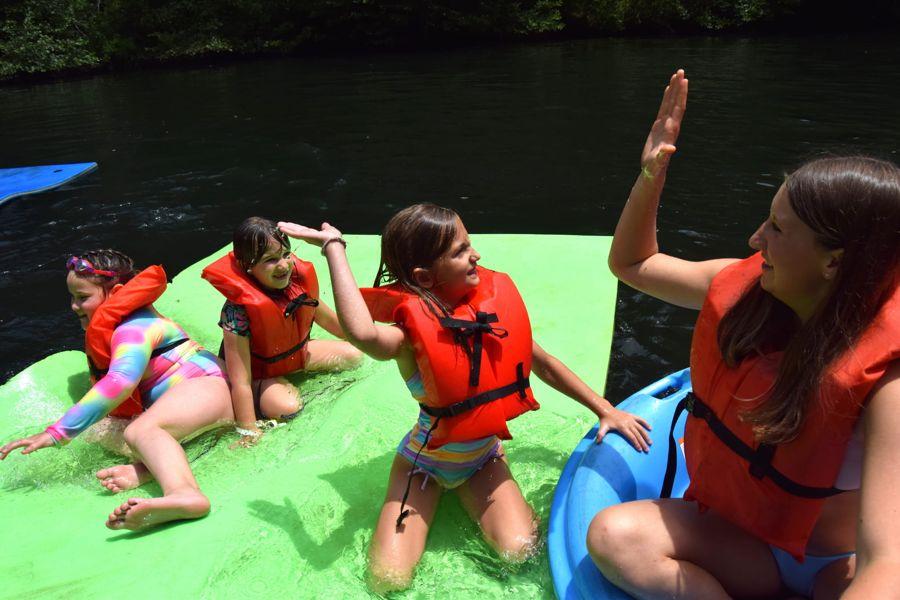
Research recommends that children spend at least two hours per week in nature for measurable health benefits. A single canoeing session at camp can meet or exceed that threshold in one afternoon, and girls who canoe regularly throughout a camp session accumulate nature exposure that produces lasting improvements in mood, focus, and emotional regulation. The river and water blob are other ways our campers connect with Little River, and the combination of water activities across a camp session gives girls sustained blue-space exposure that research shows is particularly beneficial for mental health.
What Age Can Kids Go Canoeing?
Kids can go canoeing as early as age 4 or 5 as passengers in a canoe paddled by adults, and most children are ready to begin learning basic paddling skills between ages 6 and 8. The key readiness indicators are the ability to wear a life jacket without removing it, the ability to follow safety instructions, and the physical coordination to hold and move a paddle.
At camp, canoeing instruction is structured by age and ability. Younger campers start with short, calm-water paddling sessions led by trained instructors. Older campers progress to longer trips, more challenging conditions, and greater independence on the water. This progressive structure mirrors the walk-trot-canter progression in horseback riding, where each skill level builds on the one before it and each new challenge rests on a foundation of previous success. A girl who starts canoeing at age 6 and returns to camp each summer can progress from passenger to novice paddler to confident navigator over multiple sessions, building water competence and self-confidence at her own pace.
The structured camp environment provides ideal conditions for learning to canoe safely. Trained instructors supervise every session, life jackets are mandatory, and the water conditions are selected to match each camper’s experience level. Our daily schedule includes multiple activity periods where girls choose their own activities, and canoeing is one of the most popular choices across every age group we serve, from our youngest campers experiencing the water for the first time to our oldest campers leading trips along the river.
What Life Skills Does Canoeing Teach Children?
Canoeing teaches children communication, collaboration, problem-solving, perseverance, environmental awareness, and personal responsibility through direct experience on the water. Every paddle stroke, every decision on the water, and every interaction with a partner or the natural environment reinforces skills that transfer directly into school, friendships, and future professional life. The breadth of life skills that paddling on the river develops is part of what makes it one of the most requested activities at camp.
The life skills that canoeing develops include:
- Clear, direct communication with a partner under real-time conditions that require immediate response.
- Collaborative decision-making where both paddlers must agree on direction, speed, and approach to navigate effectively.
- Problem-solving under changing conditions, including wind shifts, current changes, and unexpected obstacles.
- Perseverance through physical challenge, because paddling against a current or into a headwind requires sustained effort and mental toughness.
- Environmental stewardship through direct observation and respectful interaction with wildlife and waterways.
- Personal responsibility for equipment, safety protocols, and the wellbeing of a paddling partner.
The ACA reports that 96% of campers make new friends during their camp session, and canoeing is one of the activities where friendships form the fastest because the shared physical challenge and the close proximity in the boat create natural bonding opportunities. A shy camper who struggles to initiate conversation on land often opens up in a canoe because the focus is on the shared task rather than on social performance. The paddle becomes the conversation starter, and the friendship grows from there.
Frequently Asked Questions
Do Kids Need to Know How To Swim Before Canoeing?
Kids do not need to be strong swimmers before canoeing, but basic water comfort is helpful. All campers wear properly fitted life jackets during every canoeing session, and instructors supervise all water activities closely. Most camps require a swim test or water comfort assessment before allowing campers to participate in water activities, and canoeing instruction starts on calm, shallow water to build comfort gradually.
What Should Kids Wear for Canoeing?
Kids should wear clothes they do not mind getting wet, closed-toe shoes or water sandals with straps, sunscreen, and a hat for sun protection. Avoid loose clothing that can catch on equipment or drag in the water. A life jacket is required at all times on the water and is provided by most camp programs.
Is Canoeing Safer Than Kayaking for Kids?
Canoeing is generally a strong starting point for kids because canoes have a wider, more stable hull than kayaks, an open design that allows children to move freely, and the capacity for an instructor or adult to ride along during early sessions. Both canoeing and kayaking are safe when supervised by trained staff with proper safety equipment in place.
How Long Does It Take a Child To Learn To Canoe?
Most children learn basic paddling skills within one or two sessions, including how to hold the paddle, execute a forward stroke, and steer the canoe. More advanced skills like J-strokes, draw strokes, and handling moving water develop over multiple sessions and multiple summers. The progressive skill structure at camp allows each girl to advance at her own pace.
Can Canoeing Help with Anxiety in Children?
Canoeing can help with anxiety in children because the rhythmic motion of paddling, the calming effect of water, and the present-moment focus required to navigate a canoe all work together to reduce stress hormones and promote relaxation. Research confirms that as little as 15 minutes in a natural setting can lower cortisol levels, and canoeing combines nature exposure with physical activity for a compounded calming effect.
Wrapping It Up
Canoeing gives kids a full-body workout, teaches them to communicate and collaborate with a partner, builds problem-solving skills through real-time navigation, connects them to the natural world in a way that screens cannot, and develops water safety awareness that lasts a lifetime. The benefits are physical, mental, emotional, and social, and they compound across every session a girl spends on the water.
We see the impact of canoeing every summer. A girl who grips her paddle nervously on day one is gliding confidently down the river by the end of the session, calling out directions to her partner and spotting wildlife along the banks. That transformation is not accidental. It is the result of trained instructors, a structured progression, and a river that offers something new around every bend. Riverview Camp for Girls offers canoeing on Little River as one of over 20 activities girls can choose from, and it remains one of the most requested experiences across every age group. Call us at 800-882-0722 or visit our enrollment page to give your daughter a summer on the water.