A ropes course is an elevated obstacle course made up of bridges, cargo nets, climbing walls, balance beams, and zip lines where participants wear a safety harness and navigate physical challenges at varying heights. Ropes courses build confidence, physical strength, teamwork, and problem-solving skills in children, which is why they have become one of the most popular activities at summer camps across the country. According to researchers Haras, Bunting, and Witt, approximately 10,000 ropes courses operate in schools, camps, therapeutic institutions, and park districts in the United States, with about 250 new courses built every year. A meta-analysis of 44 challenge course studies published in the Journal of Experiential Education found a statistically significant medium effect size for participation outcomes, confirming what camp counselors and parents observe firsthand: kids who complete a ropes course walk away measurably more confident than when they started. This article covers what a ropes course is, the different types, why it benefits children, what to wear, and what a first-time experience looks like.
What Does “Ropes Course” Mean?
“Ropes course” means an outdoor obstacle course constructed from ropes, cables, wood platforms, and metal hardware that challenges participants to climb, balance, traverse, and sometimes swing or zip between elevated stations. The term originated in military training programs in the 1940s, where rope-based obstacle courses were used to build physical fitness, mental toughness, and unit cohesion in soldiers. Civilian programs adapted the military model for youth development, corporate team building, and therapeutic settings beginning in the 1960s and 1970s. By the 1980s, the ropes course industry had grown from approximately 700 to 800 courses nationwide to the more than 15,000 that operate today, according to industry data cited by iPlay America.
A ropes course at a summer camp functions differently from a commercial adventure park. Camp ropes courses are facilitated by trained staff who guide participants through each element, debrief the experience afterward, and connect the physical challenge to broader lessons about trust, communication, and perseverance. The facilitation transforms what could be just a physical obstacle into a developmental experience with lasting emotional and social impact. The Association for Challenge Course Technology (ACCT), founded in 1993 and recognized as an ANSI Accredited Standards Developer since 2006, sets the safety and operational standards that reputable camp programs follow.
What Are the Different Types of Ropes Courses?
The different types of ropes courses are low ropes courses and high ropes courses. Each type serves a distinct developmental purpose, and most camp programs use both as part of a progression that builds skills and confidence in stages.
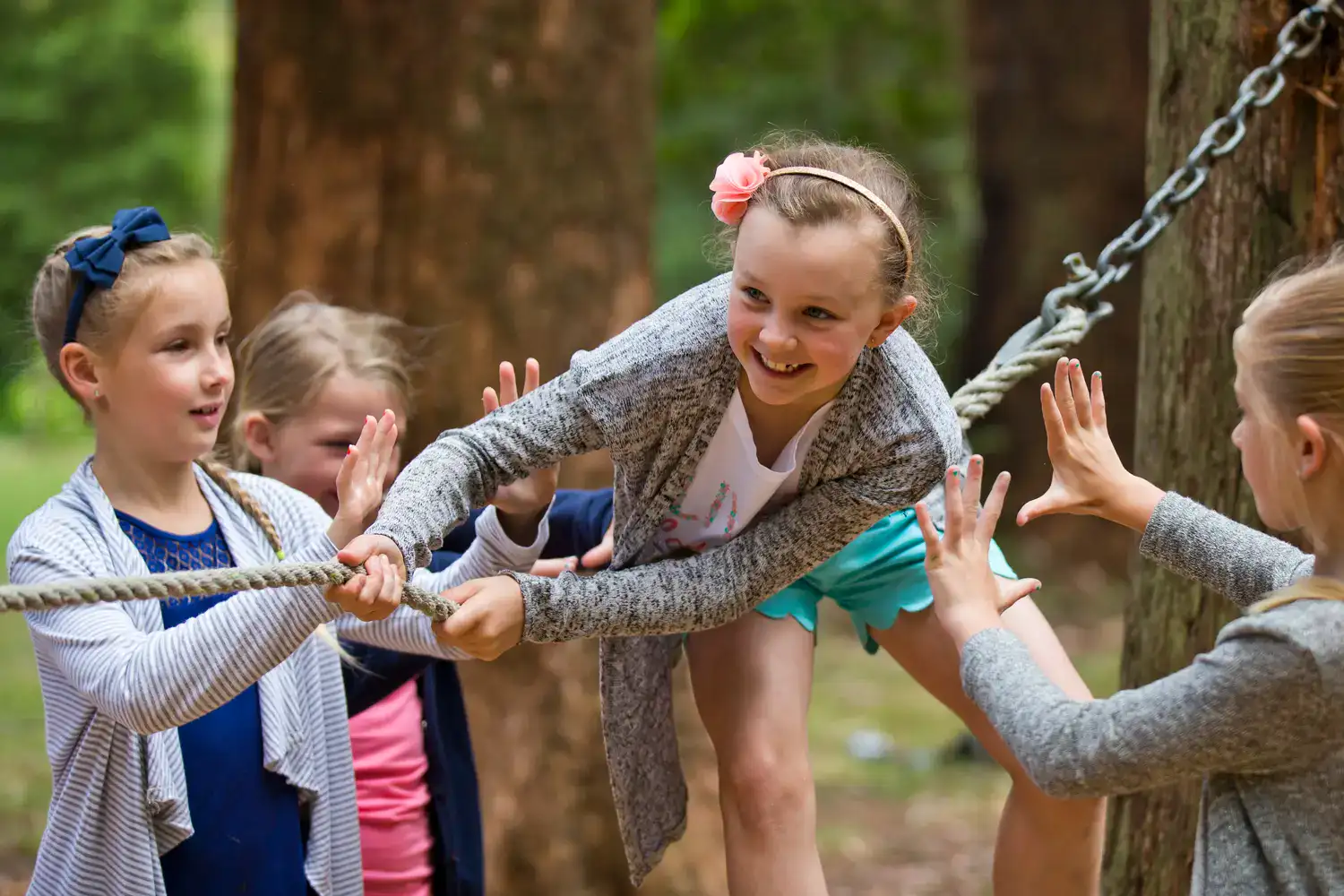
Low ropes courses consist of elements installed close to the ground, typically under 12 feet high. Participants do not wear harnesses on low ropes elements because the height does not require fall-protection equipment. Instead, teammates stand around the participant as “spotters,” ready to assist if someone loses balance. Low ropes elements include trust falls, balance beams, group problem-solving platforms, partner walks on parallel cables, and traverses where the group must work together to move everyone from one point to another. The primary purpose of low ropes is teamwork, communication, and trust-building. Children learn to rely on each other, give and receive verbal directions, and support a teammate who is struggling before anyone goes up to the high course.
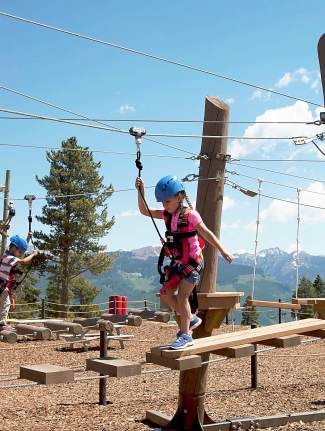
High ropes courses consist of elements installed 15 to 50 feet above the ground, anchored to trees, poles, or tower structures. Participants wear full-body harnesses connected to a belay system that keeps them secured to a safety cable throughout the experience. High ropes elements include cargo net climbs, rope bridges, zip lines, the “leap of faith” (jumping from a platform to catch a trapeze bar), balance logs, vertical climbing walls, and the giant swing. The primary purpose of high ropes is individual confidence-building through managed risk. The child faces a physical challenge that feels genuinely scary, pushes through the fear, and succeeds with the support of staff and peers below. That sequence, fear followed by action followed by accomplishment, is the mechanism that produces lasting self-esteem gains.
A ropes course is also commonly called a challenge course, an adventure course, or an obstacle course. These names describe the same category of activity, though “challenge course” is the preferred industry term used by ACCT and most professional facilitators.
What Are the Benefits of a Ropes Course for Kids?
The benefits of a ropes course for kids span four developmental categories: physical fitness, mental and emotional growth, social skill development, and cognitive gains. Each category reinforces the others, which is why ropes courses produce broader developmental outcomes than most single-activity programs.
Physical benefits include improved upper-body and core strength, better balance, increased grip strength, enhanced coordination, and greater overall endurance. Climbing cargo nets and rope ladders requires children to pull their own body weight upward, which builds lean muscle mass in the arms, shoulders, back, and core. Traversing balance beams and cable bridges strengthens stabilizer muscles in the legs and torso. The World Health Organization recommends at least 60 minutes of moderate-to-vigorous physical activity per day for children, and a ropes course session delivers a concentrated full-body workout that meets or exceeds that threshold in a single activity period. Research published in F1000Research found that children who participate in outdoor climbing activities develop more advanced motor skills than children who spend most of their time indoors, including gains in agility, balance, and bilateral coordination.
Mental and emotional benefits include increased self-confidence, reduced fear of the unfamiliar, improved stress management, and a stronger internal sense of control over challenging situations. The Gillis and Speelman (2008) meta-analysis of 44 challenge course studies found that self-esteem or self-concept was the most frequently measured outcome, appearing in 45.5% of the studies reviewed, and that participation produced consistent positive changes. Physical activity has also been shown to reduce stress by increasing norepinephrine, a brain chemical that helps regulate the stress response, according to research cited by Huffington Post reporter Abigail Wise.
Social benefits include stronger teamwork skills, improved verbal communication, deeper trust between peers, and better conflict resolution abilities. Low ropes elements require groups to solve physical puzzles together, which forces children to listen to each other, negotiate strategies, and support teammates who struggle. High ropes elements build social bonds through shared vulnerability: a child cheering for her cabin mate 30 feet above the ground creates a connection that carries over into every other camp activity. The ACA found that 96% of campers made new friends at camp, and shared challenge experiences like the ropes course are among the strongest friendship accelerators.
Cognitive benefits include improved problem-solving skills, better spatial awareness, enhanced focus and concentration, and stronger decision-making under pressure. Each ropes course element presents a puzzle: where to place your foot, which hand to reach with, how to shift your weight to maintain balance. These micro-decisions build neural pathways that support executive function development. Research from Park N Play Design and other child development sources confirms that climbing activities improve concentration, memory recall, and attention span in school-aged children.
How Does a Ropes Course Build Confidence in Kids?
A ropes course builds confidence in kids through a specific psychological mechanism: the child faces a challenge that feels genuinely frightening, chooses to attempt it anyway, receives support from peers and staff, and succeeds. That sequence produces what psychologists call “earned self-efficacy,” confidence that comes from real accomplishment rather than empty praise. The ACA’s Value of Camp data shows that 74% of campers did things at camp they were initially afraid to do, and ropes courses rank among the most common activities where that breakthrough happens.
The “challenge by choice” philosophy, a cornerstone of professional ropes course facilitation, strengthens the confidence-building effect. Challenge by choice means every participant decides her own level of engagement. A child who climbs halfway up the cargo net and stops has still succeeded, because she pushed past her starting point and chose her own boundary. No one is forced to complete every element. This ownership over the decision produces deeper confidence than a forced completion would, because the child knows she chose to try. Cason and Gillis (1994) reported that adolescents who participated in adventure programming scored better than 62% of adolescents who did not participate, demonstrating that the benefits extend well beyond the course itself.
What Are the Benefits of an Obstacle Course for Kids?
The benefits of an obstacle course for kids include all the physical, emotional, social, and cognitive gains described above, plus the additional benefit of sustained engagement. Obstacle courses, whether ground-level or elevated, hold children’s attention because every element is different. A child who loses interest after 10 minutes of running laps will stay focused for an hour on a course that alternates between climbing, balancing, swinging, crawling, and problem-solving. This sustained engagement produces longer exposure to physical activity, which compounds the fitness and developmental benefits. An obstacle course at camp also integrates naturally with other activities: a child who builds core strength on the challenge course in the morning performs better in canoeing or horseback riding in the afternoon.
What Do Kids Learn on a Ropes Course?
Kids learn teamwork, communication, perseverance, self-regulation, trust, and problem-solving on a ropes course. These skills develop through direct experience rather than instruction, which makes them stick in ways that classroom lessons often do not. A child does not learn to trust her teammate by hearing a lecture about trust. She learns to trust her teammate by standing on a wobbly platform 25 feet in the air and listening to her teammate’s voice calling directions from below.
Perseverance develops when a child attempts an element, fails, regroups, and tries again. The ropes course makes the cost of failure low (the harness catches you) and the reward of persistence high (you complete the element and your cabin cheers). Self-regulation develops because the child must manage her fear response in real time. A racing heart and shaky hands are normal on a high ropes element, and learning to breathe, focus, and move despite those sensations is a transferable skill that helps in school, in sports, and in social situations long after camp ends.
Communication skills develop on low ropes elements where the group must solve physical challenges together. A blindfolded trust walk, a group balance platform, or a “spider web” element where the team must pass each member through openings in a rope web without touching the ropes all require clear, specific verbal communication. Children learn to give precise directions (“step six inches to your left”) instead of vague ones (“go that way”), a skill that translates to every other camp activity and to the classroom.
| Benefit Category | What the Ropes Course Develops | Supporting Evidence |
| Physical | Upper-body and core strength, grip strength, balance, coordination, endurance, agility | WHO recommends 60 min/day of moderate-to-vigorous activity for children; climbing provides full-body resistance training using body weight |
| Mental / Emotional | Self-confidence, self-esteem, fear management, stress reduction, internal locus of control | Gillis & Speelman (2008) meta-analysis of 44 studies found medium effect size; self-esteem measured in 45.5% of challenge course studies |
| Social | Teamwork, trust, verbal communication, conflict resolution, peer support | 96% of campers made new friends (ACA, 2005); ropes course research shows improved group dynamics and communication |
| Cognitive | Problem-solving, spatial awareness, focus, decision-making, sequencing | Climbing improves concentration and memory (Miracle Recreation / Park N Play Design); physical activity enhances brain function and academic performance (Dr. Amika Singh) |
Sources: Gillis & Speelman, Journal of Experiential Education (2008); American Camp Association Youth Development Outcomes Study (2005); World Health Organization physical activity guidelines; F1000Research outdoor play study; Dr. Amika Singh physical activity and cognition research.
How Hard Is a Ropes Course?
A ropes course is as hard as the participant chooses it to be. The “challenge by choice” philosophy that governs professional ropes course facilitation means every child selects her own level of difficulty. A first-time participant might attempt only the lowest elements and climb partway up the cargo net before stopping. A returning camper might complete every high ropes element and finish with the zip line. Both experiences are valid, and both produce growth.
Camp ropes courses are designed with multiple difficulty levels built into the same structure. Entry-level elements like wide balance beams and short rope bridges require basic balance and minimal upper-body strength. Intermediate elements like cargo net traverses and narrower bridges demand more grip strength, core stability, and comfort with height. Advanced elements like the leap of faith, the giant swing, and vertical climbing walls require significant upper-body strength, courage, and the ability to manage an intense fear response. This layered design allows children of different ages, fitness levels, and comfort zones to participate on the same course simultaneously.
The physical demands are real but accessible. A child does not need to be an athlete to succeed on a ropes course. She needs to be able to grip a rope, place one foot in front of the other, and follow basic directions. The challenge is primarily psychological, not physical. Standing on a platform 30 feet high and choosing to step onto a swaying bridge requires courage, and that courage is what produces the confidence gains research has documented. An 85-percent majority of children ages 6-12 report wanting more adventure in their lives, according to a 2010 One Poll survey, and the ropes course delivers exactly the kind of managed adventure children crave.
What Is the Best Age for a Ropes Course?
The best age for a ropes course depends on whether the course is low ropes or high ropes. Low ropes elements are appropriate for children as young as 5 or 6, because the activities take place close to the ground with spotters and do not require heavy physical strength. High ropes elements typically require children to be at least 7 or 8 years old, with most camp programs setting a minimum age based on the child’s ability to fit properly into a safety harness and follow multi-step safety instructions.
The ideal age range for a full camp ropes course experience is 7 to 16 years old. Children in this range have sufficient physical development (core strength, grip strength, limb length) and cognitive maturity (ability to follow safety briefings, manage fear responses, communicate with belayers) to participate safely and benefit fully. Younger children within this range typically spend more time on low ropes and introductory high ropes elements, while older campers progress to the most challenging high ropes activities.
Camp programs adapt the ropes course experience to each age group. Younger campers receive more hands-on guidance, shorter sessions, and simpler elements. Older campers receive more autonomy, longer sessions, and access to advanced elements. This age-appropriate scaffolding allows every camper to be challenged at her developmental level without being overwhelmed. The result is a positive experience that builds genuine confidence rather than a frightening one that creates resistance to future attempts.
Is a Ropes Course Safe for Children?
Yes, a ropes course is safe for children when the course follows established industry standards, uses properly maintained equipment, and is staffed by trained facilitators. The Association for Challenge Course Technology (ACCT) publishes comprehensive safety standards covering course construction, equipment inspection, staff training, participant management, and emergency procedures. Camps that hold accreditation from organizations like the ACA and ACCT undergo regular review of their ropes course operations, including annual third-party inspections of every cable, carabiner, harness, and anchor point.
Modern ropes courses use continuous belay systems that keep the participant clipped into a safety cable from the moment she leaves the ground until she returns. Continuous belay technology uses synchronized carabiners where only one can open at a time, making it physically impossible for the participant to become detached from the safety line while on the course. This system eliminates the most significant risk factor in older ropes course designs, where participants had to manually transfer their connection between elements.
Safety briefings before every session cover proper harness fitting, belay procedures, course rules, and how to communicate with staff during the experience. Facilitators monitor participants throughout the session and can assist anyone who needs help, whether that means verbal encouragement or a physical rescue from an element. Daily equipment inspections verify that every component meets operational standards before any participant touches the course. At our camp, the high ropes program follows ACCT guidelines and ACA standards, and our staff completes certification training before the summer begins.
How to Dress for a Ropes Course?
How to dress for a ropes course is straightforward: wear clothing that allows full range of motion and closed-toe shoes with good grip. The specific checklist includes:
- Closed-toe athletic shoes or hiking shoes with rubber soles. Sandals, flip-flops, and shoes without backs are never permitted because they cannot stay secured during climbing and do not provide adequate grip on platforms and beams.
- Comfortable athletic clothing that allows stretching, reaching, and bending. Shorts or athletic pants work well. Avoid skirts, dresses, or very loose clothing that could catch on equipment.
- Hair tied back securely if it is long enough to fall across the face. Loose hair can obstruct vision during climbing and get tangled in harness straps or carabiners.
- No jewelry, dangling earrings, or loose accessories that could catch on ropes, cables, or hardware. Remove rings, bracelets, and necklaces before the safety briefing.
- Sunscreen and insect repellent applied before the session, since ropes courses at camp are outdoors in wooded settings where sun exposure and insects are common.
Camp packing lists typically include these items. Reviewing what to expect at camp ahead of time helps families prepare the right gear for ropes course days and every other activity on the schedule.
What Should a Child Expect on a Ropes Course for the First Time?
A child should expect a ropes course for the first time to follow a clear progression that moves from ground-level preparation to elevated challenges at a pace the child controls. The typical first-time experience at a camp ropes course unfolds in this order:
- Safety briefing on the ground covers harness fitting, helmet placement (if required), how the belay system works, hand signals for communication, and the “challenge by choice” principle. The facilitator demonstrates every step before anyone leaves the ground.
- Harness fitting and equipment check ensures every buckle is doubled back, every strap is snug, and every connection point is secure. Staff check each participant individually before clearing her to approach the course.
- Low ropes warm-up activities, like a group balance challenge or a trust exercise, get the group working together and build familiarity with the outdoor setting. These ground-level activities reduce nervousness and establish the supportive group dynamic that carries onto the high course.
- First climb onto the high ropes platform introduces the child to the feeling of height in a controlled setting. The facilitator is nearby, the belay line is taut, and the child can look down and see her teammates cheering from below.
- Navigation through the elements proceeds at the child’s own pace. She may complete every element or she may attempt three and come down. Both outcomes are celebrated because the goal is personal growth, not course completion.
- Debrief after the session gives the group a chance to talk about what they experienced, what scared them, what surprised them, and what they learned about themselves. This reflection is what transforms the physical activity into a developmental experience.
Most children feel nervous before their first ropes course and exhilarated afterward. The gap between “I can’t do that” and “I just did that” is where the confidence lives. Nestled among the tall pines of Lookout Mountain in Mentone, Alabama, the ropes course at our camp gives girls a place to discover that gap in a setting surrounded by nature, friendship, and support. The skills a child builds on the ropes course transfer directly to swimming, arts and crafts, outdoor living skills, and every other part of the camp day.
Frequently Asked Questions
Can a Child with a Fear of Heights Do a Ropes Course?
Yes, a child with a fear of heights can do a ropes course, and many facilitators consider these children the ones who benefit the most. The “challenge by choice” philosophy means no child is forced onto any element she does not want to attempt. Low ropes activities happen close to the ground and require no height tolerance at all. On the high course, a child can climb to whatever height feels manageable and stop there. Even climbing 10 feet, pausing, and coming back down is a genuine accomplishment for a child who started the day afraid to leave the ground. The ACA found that 74% of campers did things at camp they were initially afraid to do, and the ropes course is one of the activities where that breakthrough most often occurs.
How Long Does a Ropes Course Take?
A ropes course session at summer camp typically takes 60 to 90 minutes, including the safety briefing, harness fitting, warm-up activities, the course itself, and the debrief. The actual time on the high elements varies by participant: some children move through elements quickly, while others take more time at each station. Camp schedules build the ropes course into the daily activity rotation so every camper has a chance to participate during her session.
Do Kids Need Experience Before Trying a Ropes Course?
No, kids do not need any prior experience before trying a ropes course. Camp ropes courses are specifically designed for beginners. The safety briefing teaches every skill the child needs, from how to clip into the belay system to how to grip a rope properly. Facilitators guide first-time participants through each element and provide hands-on assistance wherever needed. A child who has never climbed anything taller than a playground structure can succeed on a camp ropes course.
What Is the Difference Between a Ropes Course and a Zip Line?
The difference between a ropes course and a zip line is that a ropes course requires the participant to actively navigate obstacles using balance, strength, and problem-solving, while a zip line is a passive ride where the participant clips onto a cable and glides from one point to another. Many ropes courses include a zip line as the final element, serving as a thrilling reward for completing the climbing and traversing challenges. The ropes course builds the skills; the zip line celebrates the accomplishment.
Are Ropes Courses Only for Athletic Kids?
No, ropes courses are not only for athletic kids. The challenge is primarily mental, not physical. A child needs basic grip strength and the ability to place one foot in front of the other, which most children possess by age 7. The “challenge by choice” model means every child participates at her own level. A child who cannot complete a pull-up can still navigate a cargo net, cross a rope bridge, and finish the zip line. Ropes courses meet children where they are and help them grow from that starting point, regardless of athletic background.
What’s Another Name for Ropes Course?
Another name for a ropes course is a challenge course, an adventure course, or an aerial obstacle course. “Challenge course” is the most common industry term used by the Association for Challenge Course Technology (ACCT) and professional facilitators. “Adventure course” is used by many commercial parks and camp programs. All three names refer to the same category of elevated and ground-level obstacle experiences designed to build physical fitness, confidence, and teamwork.
The Bottom Line
A ropes course is one of the most effective activities a summer camp can offer because it develops the whole child, body, mind, and social skills, in a single experience. The research confirms what every camper who has stepped onto a swaying bridge 30 feet above the ground already knows: pushing through fear and succeeding on the other side changes how you see yourself. Sixty percent of camp alumni report that camp helped shape their independence, teamwork, and leadership years after the last summer ended, and the ropes course is often the activity they remember most vividly.
If your daughter is ready for an adventure that builds real confidence, lasting friendships, and physical strength she can feel, Riverview Camp for Girls has a ropes course waiting for her. Enroll today and let her discover what she is capable of.